When looking for a startup accounting platform, it’s easy to get hung up on features: who reconciles Stripe faster, who supports classes and departments, whose dashboard is prettier, etc. However, Puzzle and Fondo don’t sort that way neatly. They market to the same venture-backed founder and solve the same underlying problem, but they’re not the same kind of company, and the feature grid obscures more than it reveals.
Puzzle is accounting software, while Fondo is an accounting service. Everything else, like the pricing, the response times, the tax coverage, the amount of your week this consumes, falls out of this one distinction. Let’s dive deeper into Puzzle vs Fondo:
The Bottom Line Up Front
If you want to own your general ledger, see cash, burn, and runway update continuously, and either do the bookkeeping yourself or hand it to a controller who works inside your system, Puzzle is the fit. If you want to hand the whole function to someone else — books closed, corporate return filed, franchise tax handled, no ledger to learn — then Fondo is the fit.
Puzzle sells you a platform and lets you bring the labor. Fondo sells you the labor and includes the platform. The right answer depends on whether financial visibility is something you want daily or something you want delivered.
The Model: The Fundamental Difference
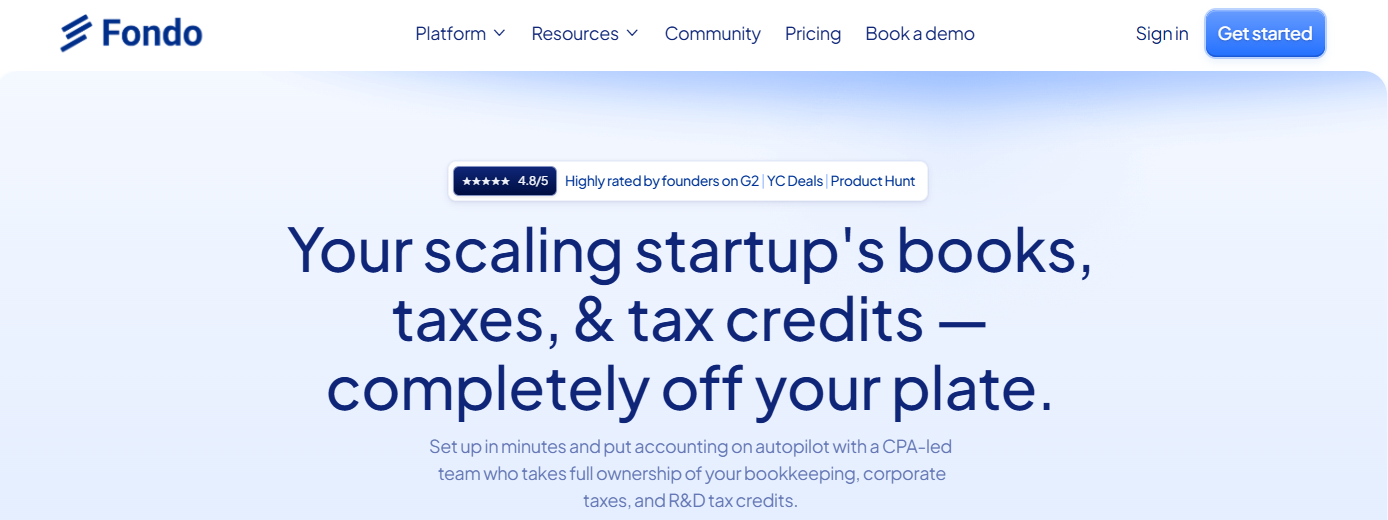
Fondo’s pitch is fully outsourcing bookkeeping, taxes, and R&D credits without you having to learn QuickBooks. You connect banks, payroll, and payment processors, and a dedicated accountant takes it from there. You get a Slack channel, a finance dashboard, and closed books on whatever cadence you’re paying for. The deliverable is a finished period: P&L, balance sheet, cash flow, runway report.
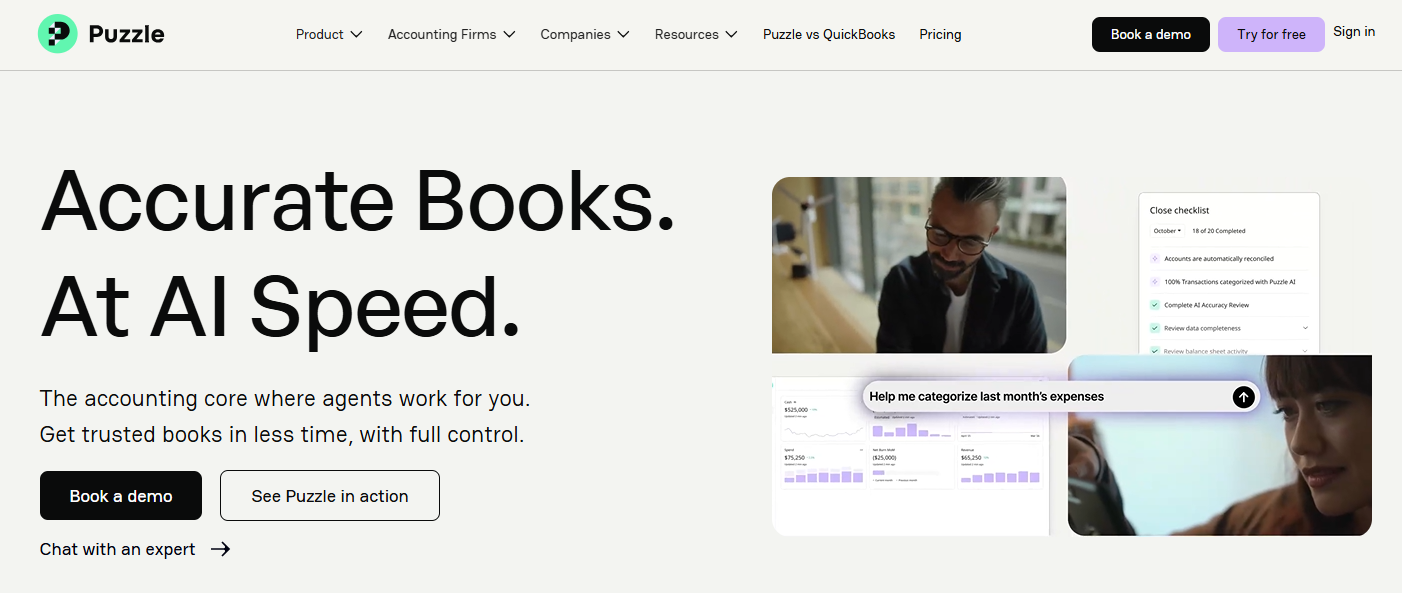
Puzzle, on the other hand, is a general ledger with automation built into it rather than layered on top. Transactions flow in from native integrations, get categorized automatically, and post to a ledger you’re logged into. The accrual automation runs continuously, such as prepaid schedules, fixed asset depreciation, and bill matching, and the system maintains cash and accrual views of the same transaction data. So the deliverable isn’t a report you receive; it’s books that are more or less current at any given moment.
That’s the whole comparison in a nutshell. One model optimizes for you not thinking about accounting; the other optimizes for you being able to look at it whenever you want.
Real-Time Visibility vs. Done-for-You Delegation
Fondo’s dashboards update after each close. Between closes, you have bank balances and whatever you’re tracking in a spreadsheet, which, for a lot of pre-seed companies, is fine. If your burn is flat and your revenue is zero, a monthly number isn’t meaningfully worse than a daily one.
It stops being fine once you’re recognizing revenue, running a sales team, or watching runway inside a six-month fundraising window. That’s when the gap between “what happened last month” and “what’s happening now” starts costing you decisions.
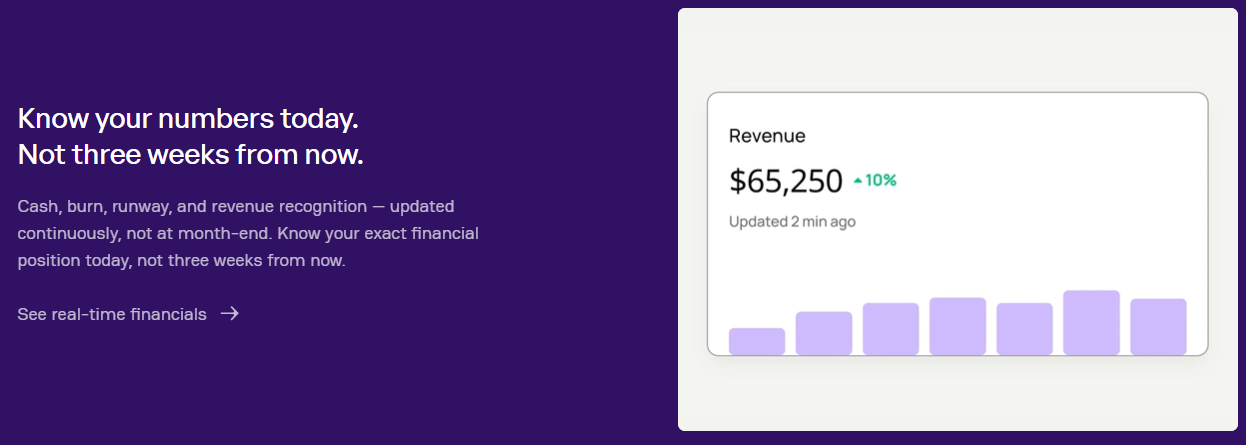
Puzzle’s continuous reconciliation is aimed squarely at that moment: Its startup positioning is built around knowing your numbers every day rather than every close cycle.
The caveat is that real-time books are only real-time if someone is keeping up with the exceptions. Auto-categorization at 98% still leaves 2%, and that 2% is disproportionately the transactions that matter (ambiguous vendor payments, the customer refund, the transfer that isn’t income). Puzzle’s model assumes a human reviews and approves before things post. If nobody on your side is doing that approving, you have a very sophisticated ledger that’s drifting out of date.
Fondo’s model has no equivalent failure mode, because the accountant clearing exceptions is the product.
Where Tax and Compliance Lands
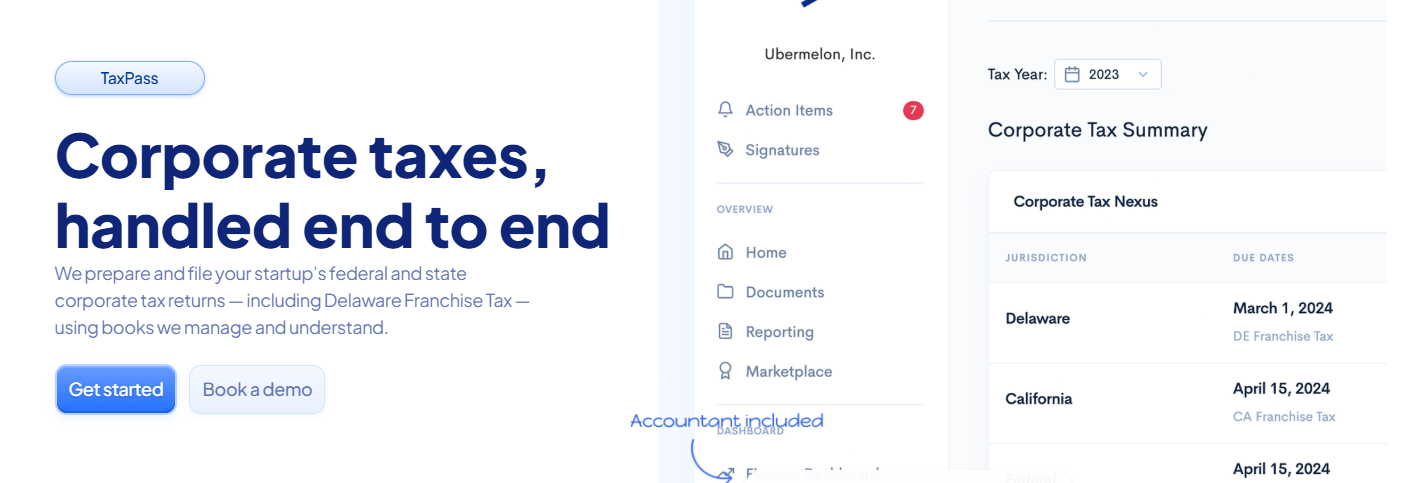
Fondo bundles compliance as a first-class product. TaxPass, priced around $1,450 a year at the time of writing, covers a dedicated tax accountant, federal Form 1120, one state corporate filing, Delaware franchise tax, and one foreign shareholder filing. Add-ons start around $500 each for multi-state, international forms like 5471 and 5472, and R&D credit work on Form 6765. It’s not free, but it’s a defined scope with a defined price, and the filings actually get made by the same organization keeping your books.
Puzzle does not file your taxes; tax preparation, R&D credits, and CFO advisory are purchased elsewhere. However, your ledger vendor and your tax preparer being different firms is normal, and it lets you pick a preparer who actually knows your situation instead of accepting whoever’s in the queue. There’s also a real cost to it: You’re managing two relationships and two invoices, and the handoff quality depends on how clean your books are.
If you’re a first-time founder who has never filed an 1120 and doesn’t know Delaware franchise tax is calculated two different ways, the bundled version removes a category of risk you may not be able to price. If you already have a CPA relationship you trust, the partner model is more flexible.
Cost Structure
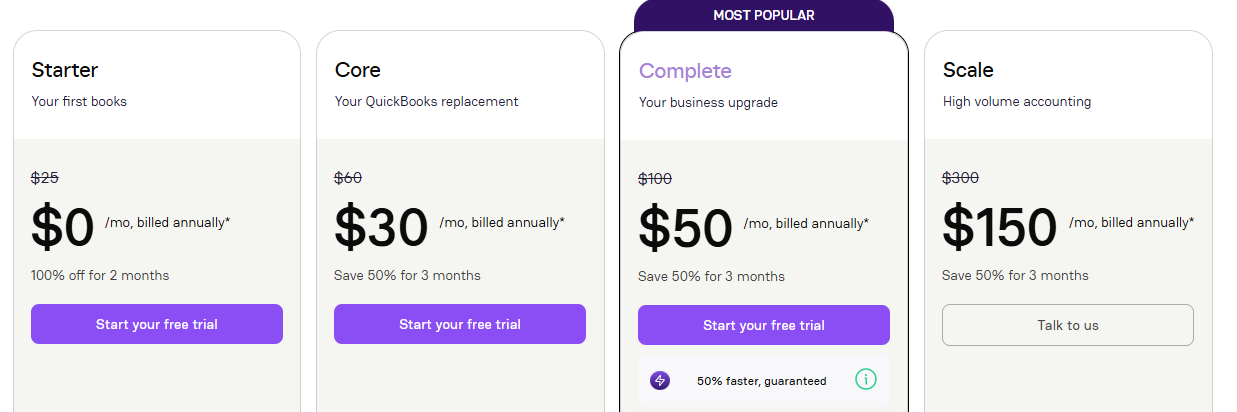
So, what’s all this cost? The sticker prices look like they’re an order of magnitude apart — and they are, but they’re buying different things.
Puzzle runs from $25/month (Starter, annual billing, single user) through Core at $60 and Complete at $100, with Scale starting around $300 for subledgers, no transaction or integration limits, and dedicated onboarding. Most funded startups land on Complete, which adds revenue recognition, classes and departments, and AI-assisted reconciliation review.
Fondo runs $399/month on the monthly-close plan, $1,198/quarter for quarterly close, or $950/year for annual. You can also get TaxPass and any catch-up work, which starts around $950.
So: Roughly $1,200/year for Puzzle Complete, plus whatever you pay a bookkeeper or your own time, versus roughly $6,200/year for Fondo monthly close plus TaxPass.
That spread is the labor. If you have a part-time controller or an ops person who can own the function, Puzzle plus that person usually comes out ahead on both cost and control. If you don’t, and you’d be buying that labor anyway, Fondo’s bundle is competitive. You’re not paying a premium for the service so much as paying for it explicitly rather than implicitly.
The failure mode on the Puzzle side is buying software and never staffing it. The failure mode on the Fondo side is paying monthly-close pricing for a company whose books could be closed quarterly without anyone noticing.
Hidden Costs: Switching Costs and What You Own

This is worth thinking about before you sign either one. With Puzzle, the ledger is yours, and you’re inside it; if you outgrow the tool or bring accounting in-house, you’re migrating a system you already understand. Puzzle also leans into the migration case directly, with white-glove QuickBooks migration on higher tiers and an integration set covering Mercury, Brex, Ramp, Stripe, Gusto, Rippling, Deel, and Plaid-connected banks.
With Fondo, you own the outputs and the underlying records, but the working knowledge lives with your dedicated accountant.
Deciding Between Platform and Service

Fondo fits the founder who has no finance function, no intention of building one this year, and a strong preference for the whole category being someone else’s problem. Pre-seed and seed companies with simple operations, a handful of vendors, and no revenue recognition complexity get value here.
Puzzle fits the founder who wants to see the numbers without asking anyone, or who has (or is about to hire) someone to own the books. It also fits companies with accrual complexity, with things such as deferred revenue, prepaid contracts, and multi-element revenue recognition where a monthly delivered close is not often enough. It also fits anyone working with an outside firm that runs on modern tooling; Puzzle’s close automation is built for firms managing many clients, so your accountant may already be in it.
The one thing that doesn’t work is buying either model and behaving like you bought the other. Paying for delegation and then trying to drive simply won’t work, nor will paying for software and expecting it to drive itself. Pick the model first, and the features will follow.