PayPal is often the first payment tool a business ever uses. It’s easy to set up, customers recognize the button, and for a new seller testing the waters, that familiarity counts for a lot. But the qualities that make PayPal a good starting point don’t always make it the right long-term home, especially once volume grows and every tenth of a percent starts showing up on the income statement.
For many business owners, the nudge to look elsewhere comes from a monthly statement that’s higher than expected, a hold on funds at a bad moment, or a dispute process that feels stacked against the seller. None of those mean PayPal is a bad product. They mean it’s worth knowing what else is out there and how the options actually compare.
The Bottom Line Up Front
For most businesses, the realistic PayPal alternatives are Stripe (online and developer-driven), Square (in-person and mixed retail), Shopify Payments (Shopify stores), Helcim (cost-conscious businesses with steady volume), and Luqra (scaling online merchants who want a dedicated account relationship). The right choice depends less on the headline rate and more on how you sell, your average ticket size, and how much support you need when something goes wrong. Many businesses keep PayPal as a checkout option while moving their core card processing elsewhere.
Why Businesses Look Beyond PayPal
The most common reason is cost. PayPal‘s pricing depends on how the payment is made. In the U.S., a PayPal or Venmo payment through PayPal Checkout costs 3.49% plus $0.49, while a card payment through the same checkout runs 2.99% plus $0.49. Businesses willing to do an API integration can get card rates starting at 2.89% plus $0.29 through Expanded Checkout. International payments add another 1.5%, and currency conversion carries its own spread on top.
The 49-cent fixed fee is what quietly hurts smaller-ticket businesses. On a $15 sale, that fee alone is more than 3% of the transaction before the percentage is even applied.
Disputes are the other sore spot. PayPal charges a $15 fee on standard disputes, refunded if the seller wins, but that rises to $30 and becomes non-refundable for merchants whose dispute rate crosses 1.5%. Card chargebacks outside of PayPal Checkout carry a separate $20 fee. For businesses in categories that naturally draw disputes, those costs add up fast.
How Fee Structures Compare
Before looking at individual providers, it helps to understand the two pricing models you’ll run into.
Flat-rate pricing charges the same percentage and fixed fee on every transaction, regardless of card type. PayPal, Stripe, Square, and Shopify Payments all use this model at their standard tiers. It’s simple and predictable, but you pay the same rate on a low-cost debit card as you do on a premium rewards card.
Interchange-plus pricing passes through the actual wholesale cost set by the card networks, then adds a fixed markup. Your rate varies by card, which makes statements harder to read, but the total is usually lower once a business processes meaningful volume.
Here’s what a single $100 domestic online card sale costs at standard published rates:
| Provider | Standard Online Rate | Fee on $100 |
| PayPal Checkout (PayPal/Venmo) | 3.49% + $0.49 | $3.98 |
| PayPal Checkout (Card) | 2.99% + $0.49 | $3.48 |
| Square (Free Plan) | 3.30% + $0.30 | $3.60 |
| Stripe | 2.90% + $0.30 | $3.20 |
| Shopify Payments (Basic) | 2.90% + $0.30 | $3.20 |
| Helcim | Interchange + 0.50% + $0.25 | Varies by card |
A 78-cent difference on one sale doesn’t sound like much, but at $50,000 a month in online sales, it’s the kind of gap that pays for a part-time employee.
What Matters for Checkout Conversion

Look, as a penny-pinching accountant, I get it. Fees get most of the attention, but a processor that saves 0.4% while losing 2% of customers at checkout is a bad trade. A few factors carry more weight than they get credit for.
Wallets matter. Apple Pay, Google Pay, and saved-card options let returning customers pay without typing a card number, and mobile shoppers are especially quick to abandon a form that asks for too much. I’m guilty of this through and through.
Redirects matter, too. Sending a buyer off your site to complete payment adds a step and a moment of doubt. Embedded or on-page checkout fields generally keep more people moving.
Finally, the PayPal button itself has value. Some customers simply prefer to pay with PayPal, and removing it entirely can cost sales. That’s why many businesses don’t drop PayPal so much as demote it, moving card processing to a cheaper provider while leaving PayPal available as one option among several.
Comparing the Five PayPal Alternatives
Luqra
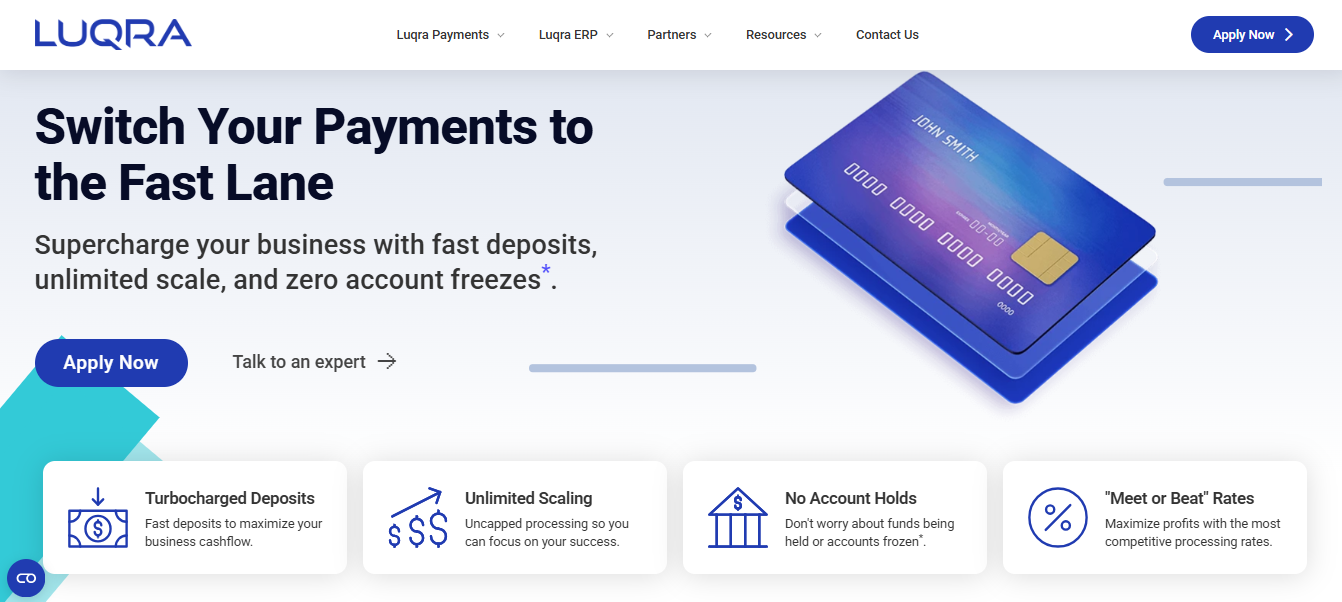
Best For: Scaling online merchants, subscription and digital goods sellers, and businesses that want a dedicated contact rather than a help center
Pricing: Published rates start at 2.0% plus $0.10 for in-person transactions and 2.3% plus $0.20 for online and keyed transactions. Final pricing for e-commerce, recurring billing, and phone orders is set through a sales conversation and may be interchange-plus or tiered. Part of their whole pitch is meet-or-beat rates, so bring an account statement.
Pros:
- Traditional merchant accounts without processing volume caps
- Dedicated account representative and 24/7 U.S.-based support
- Built-in chargeback management and fraud tools
- Meet-or-beat pricing offer against a merchant’s current processor
Cons:
- Online pricing is quoted rather than fully published, which makes quick comparisons harder.
- Smaller integration ecosystem than developer-focused platforms like Stripe
- As with any quoted merchant account, it’s worth auditing dispute-related and ancillary fees early.
Stripe
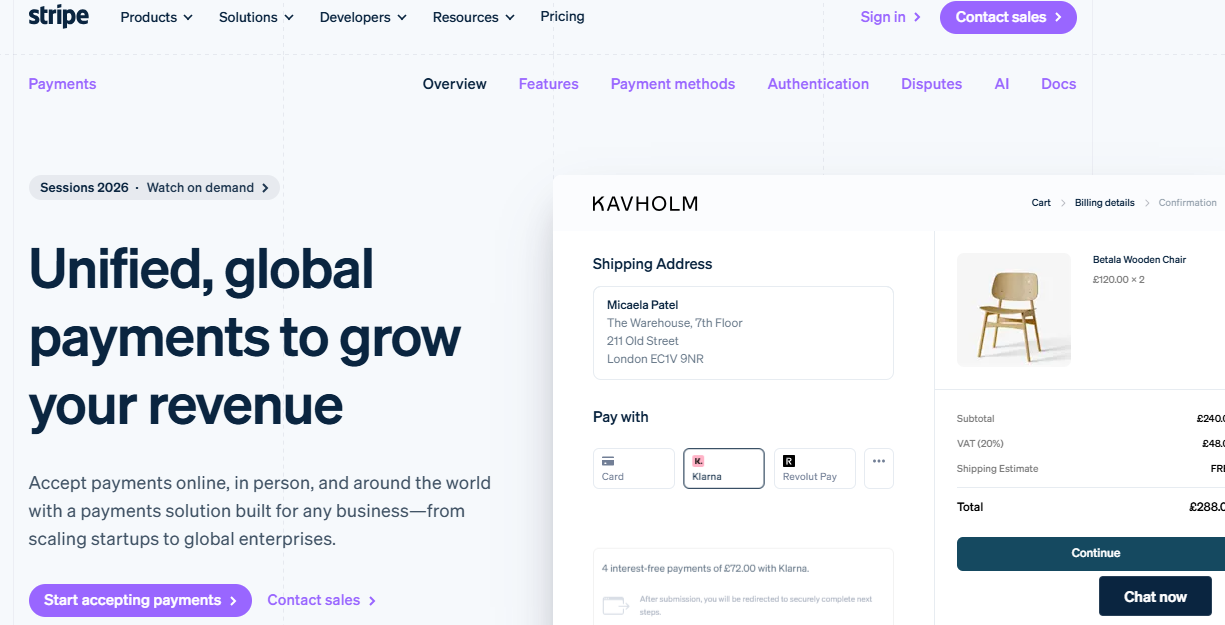
Best For: Online-first businesses, SaaS and subscription companies, and marketplaces with in-house or contracted developers
Pricing: 2.9% plus $0.30 for domestic online card payments with no monthly fee. In-person payments through Stripe Terminal cost 2.7% plus $0.05. ACH Direct Debit is 0.8%, capped at $5. International cards add 1.5%, currency conversion adds 1%, and subscription billing through Stripe Billing adds 0.7%.
Pros:
- Deep customization through well-documented APIs
- Stripe Connect handles split payments and payouts for marketplaces and platforms.
- Low-cost ACH is a strong fit for large B2B invoices
- Broad support for wallets and local payment methods
Cons:
- Add-on products (Billing, Tax, fraud tools) raise the effective rate.
- Getting the most out of it usually requires some pretty tech-savvy people, and those people are typically sort of expensive.
- Automated risk reviews can lead to holds or account closures with limited human recourse.
Square
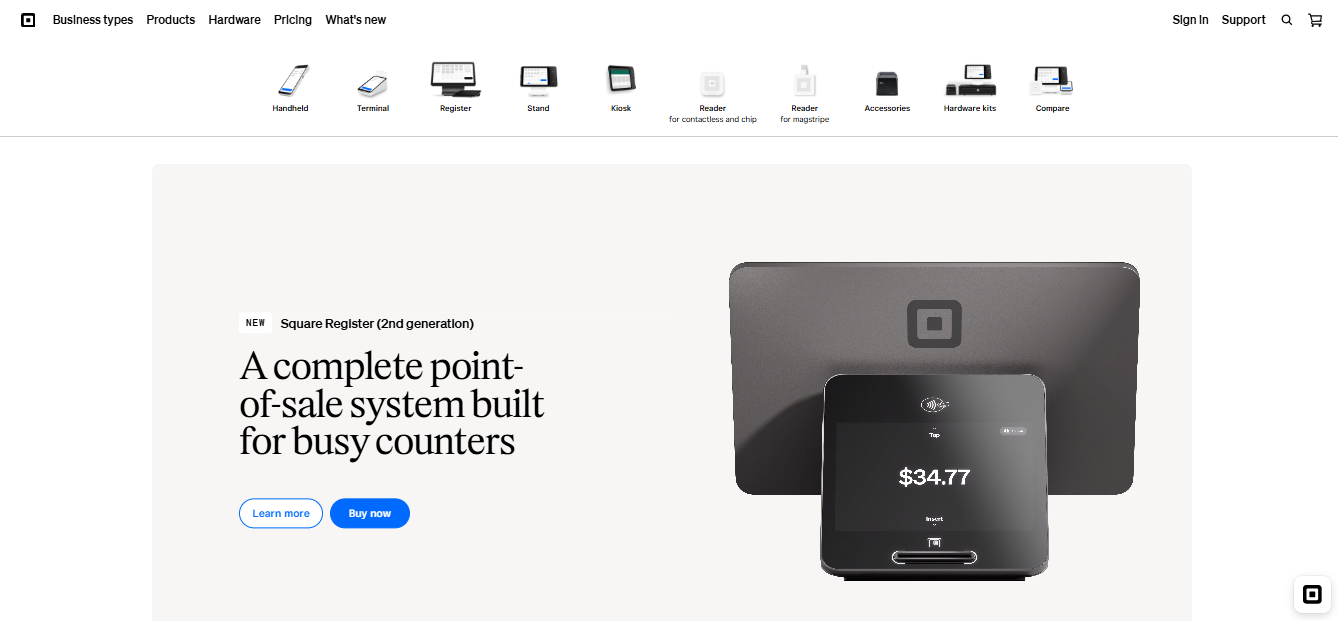
Best For: Retail shops, restaurants, service businesses, and anyone selling primarily in person
Pricing: On the Free plan, in-person payments cost 2.6% plus $0.15, online and invoice payments cost 3.3% plus $0.30, and keyed entries cost 3.5% plus $0.15. The Plus plan, at $49 per month per location, lowers the in-person rate to 2.5% plus $0.15 and online to 2.9% plus $0.30.
Pros:
- Square offers a free POS software with a polished hardware lineup.
- No separate chargeback fee
- One system for in-person, online, and invoicing
- They have some of the fastest setup with no long-term contracts.
Cons:
- Free-plan online rate is now higher than Stripe’s.
- Keyed and card-on-file payments are expensive on every plan.
- Hardware generally only works within Square’s ecosystem, which adds switching costs later.
Shopify Payments
Best For: E-commerce brands already building on Shopify
Pricing: On the Basic plan, 2.9% plus $0.30 for online cards and 2.6% plus $0.10 in person, with lower rates on higher-tier plans. Using a third-party gateway instead triggers an additional Shopify transaction fee of 2% on Basic, 1% on Grow, 0.6% on Advanced, and 0.2% on Plus.
Pros:
- Built directly into the Shopify checkout, which is well optimized for conversion
- No added platform transaction fee
- Payouts, orders, and reporting live in one dashboard.
- PayPal can still be offered alongside it as an additional payment method.
Cons:
- Only makes sense if you’re on Shopify
- Third-party gateway surcharge effectively locks you in.
- Not available in every country
Helcim
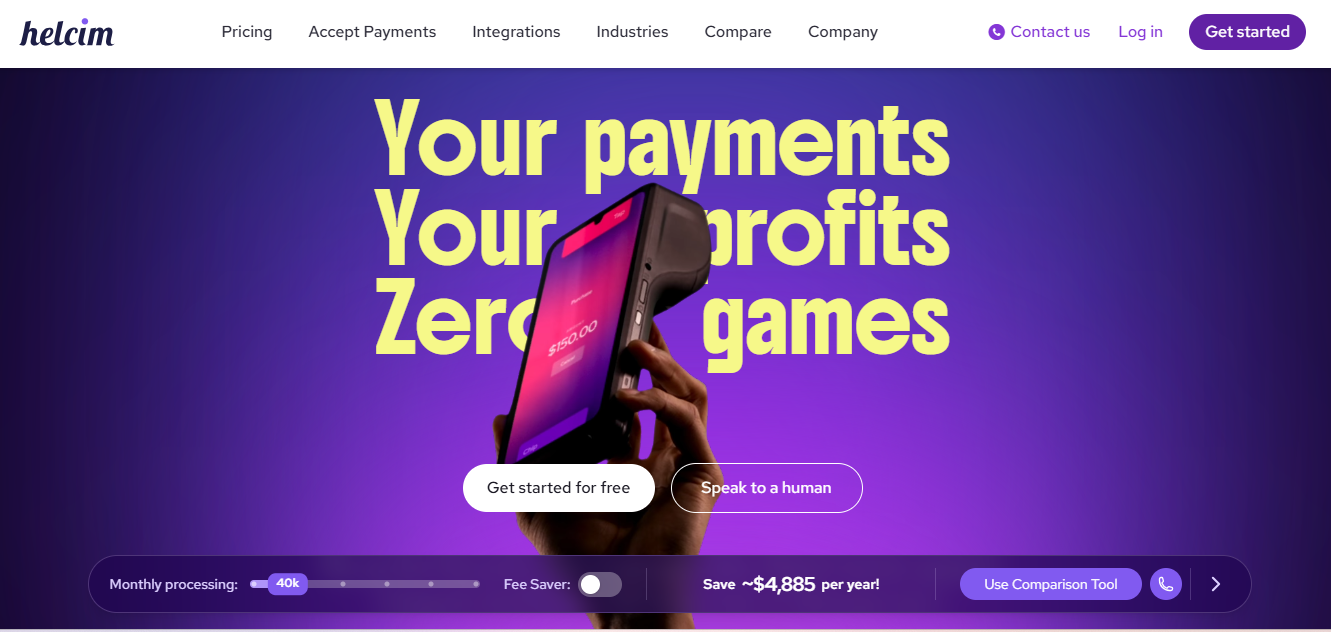
Best For: Established small and mid-sized businesses, B2B sellers, and anyone who wants transparent, cost-based pricing
Pricing: Interchange plus 0.40% and $0.08 for in-person transactions and interchange plus 0.50% and $0.25 online. There are no monthly fees, and volume discounts apply automatically based on a rolling three-month average. Recurring payments carry an additional 0.40%.
Pros:
- Interchange-plus pricing without having to negotiate
- No monthly, PCI, or cancellation fees
- Automatic volume discounts as the business grows
- Built-in invoicing, POS software, and recurring billing
Cons:
- Variable per-card costs make statements harder to predict.
- Flat-rate providers can be cheaper at very low volumes.
- Deposits can take up to two business days.
- Maintains a restricted business list, so not every industry qualifies
Matching the Provider to the Business
No single platform wins for everyone, so it helps to start with how you actually sell.
Online-first businesses will usually land on Stripe or, if they run on Shopify, Shopify Payments. Businesses that have outgrown self-serve platforms, or that have been burned by sudden holds, often move to a traditional merchant account through a provider like Luqra, where underwriting happens up front, and there’s a person to call.
In-person businesses tend to favor Square for its hardware and simplicity. Once card volume passes roughly $10,000 a month, interchange-plus pricing from a provider like Helcim is worth modeling, though switching hardware adds real cost.
Freelancers and service providers mostly need clean invoicing and cheap bank payments. Stripe’s capped ACH and Square’s invoicing both beat paying a percentage on a $5,000 project invoice.
Marketplaces and platforms that pay out to multiple sellers need split payments, seller onboarding, and tax reporting. Stripe Connect is the default here, and it’s one area where the alternatives are thin.
The Bottom Line
PayPal earned its place by being easy, but easy isn’t always efficient at scale. Stripe, Square, Shopify Payments, Helcim, and Luqra each solve a different version of the problem, and the right fit comes down to how you sell, what you sell, and how much volume runs through the account each month. Pull your last three months of statements, calculate what you’re actually paying per transaction, and compare that against two or three realistic alternatives. For most businesses, that one exercise makes the decision obvious.


