
Most small business owners can tell you their bank balance to the dollar. Far fewer can tell you what the business earned last month, how quickly cash is leaving, or how many months they could operate if revenue stalled tomorrow. That’s because the numbers that answer those questions tend to arrive two to four weeks after the fact — long after the decisions they should have helped shape.
That lag used to just be the nature of the beast, an unfortunate reality that there was no around. But this is no longer the case.
Modern banks, card programs, payroll providers, and payment processors now push data continuously, and a newer generation of accounting tools can turn that stream into reliable financials while the month is still underway. The question that remains is which approach best fits your business.
The Bottom Line Up Front
For small businesses, real-time financial insights depend on three things working together: automated data feeds from your bank and fintech tools, a ledger that categorizes and reconciles transactions continuously instead of at month-end, and a dashboard that shows cash, burn, and runway without a spreadsheet in the middle.
In my opinion and experience, the fastest way to reach this point is by using an AI-native accounting platform, while businesses with inventory or heavier operations may still need a traditional ledger paired with experienced outside help.

Why Month-End Reporting Leaves Owners a Step Behind
The traditional close follows a predictable rhythm: The month ends, and the bookkeeper downloads statements, categorizes a few hundred transactions, chases missing receipts from different employees, reconciles the accounts, and produces a profit and loss statement somewhere around the middle of the following month.
For a stable business with steady margins, that cadence is tolerable. For a company that is growing quickly, burning investor capital, or operating on thin cash reserves, it’s insufficient.
If a software subscription doubles in price in early March, a contractor bills twice for the same work, and then a large customer pays thirty days later than usual, there’s a good chance that none of that will show up in the financial report. By then, the business will have absorbed six weeks of higher spending and weaker collections without anyone deciding to do anything about it.
The problem wasn’t that the owner lacked information; the information existed the day each transaction cleared, but it wasn’t organized into anything useful until it was too late to act on.
The Building Blocks of Real-Time Visibility

First, it helps to be precise about what “real-time” actually means in this context. It doesn’t mean watching numbers change second by second like a stock ticker; it means the books are current within a day or two, transactions are categorized and reconciled as they occur, and the reports reflect the business as it stands this week and not last month.
It also means looking beyond the bank balance, which many business owners fail to do. A healthy checking account can mask unpaid vendor bills, accrued payroll, or customer prepayments that haven’t been earned yet. But real-time insight means seeing the full financial position, not just the cash sitting in one account.
With this in mind, every approach to live financial reporting rests on the same foundation. But how well a tool handles each piece determines whether its dashboard is genuinely current or just a prettier view of stale data.
Automated Bank and Fintech Sync
A basic bank feed pulls in a line that says a Stripe deposit of $18,400 landed on Tuesday. What it doesn’t tell you is that the deposit represents $19,600 in gross sales, $570 in processing fees, and $630 in refunds. Someone still has to break that apart before the income statement is accurate; most of the time, they don’t, leaving revenue either overstated or understated.
Native integrations go further. Instead of reading only the bank’s side of the transaction, they connect directly to the systems where the activity originates: the payment processor, the corporate card platform, the payroll provider, the expense tool. That brings in the detail behind each number, including fees, receipts, employee-level payroll costs, and the customer tied to each charge. The more of your money movement that flows through these connected sources, the less manual reconstruction is needed and the closer your books get to real time.
Continuous Categorization and Reconciliation
Data arriving quickly doesn’t help if it sits in an uncategorized queue until month-end. That’s why the second building block is a ledger that processes transactions as they arrive.
Modern systems use machine learning trained on your own history to categorize spending, match deposits to invoices, and flag items that look unusual. The better ones keep a person in the loop, holding uncertain entries for review and keeping a full audit trail of who approved what. Automation handles the repetitive volume, while human judgment stays focused on the exceptions that actually need it.
Dashboards That Answer Real Questions
A live dashboard is only as useful as the questions it answers. For most founders, those questions are simple:
- How much cash do we have?
- How fast are we spending it?
- Is revenue trending up or down?
- How long can we keep going at this pace?
A good dashboard puts those answers on the first screen, drawn directly from the reconciled ledger and without exporting anything to a spreadsheet. If an owner needs to rebuild a model every week to understand their own business, the tool isn’t doing its job.
Accurate Burn Rate and Runway
For venture-backed startups and any business funding losses from reserves, burn rate and runway are the two numbers that matter most. If you’re a founder reading this, gross burn is total monthly spending, net burn is spending minus incoming cash (the amount your cash balance actually shrinks each month), and runway is current cash divided by average net burn — most finance leaders use a trailing three-month average to smooth out lumpy months like an annual insurance payment.
The math is simple, but keeping it accurate is not. Runway calculated from month-old books can overstate your position by weeks, and a single quarter of rising costs can erase months of cushion before anyone has any time to react. When burn and runway recalculate as transactions post, a founder can see the effect of a new hire, a lost customer, or a large contract within days and adjust before the gap becomes a crisis.
Comparing the Main Approaches
Founders looking for better visibility generally land on one of three paths. Each can work, but they deliver very different levels of immediacy.
A Traditional Ledger With Reporting Add-Ons
The most common setup pairs a general-purpose accounting system like QuickBooks Online or Xero with a reporting layer, whether that’s a dedicated FP&A tool or a well-built spreadsheet. This solution has been around for decades, and nearly every accountant knows these platforms. The app ecosystems are enormous, and they handle inventory, job costing, and multi-entity structures that newer tools may not.
The limitation is that the reporting layer can only be as current as the ledger underneath it. Bank feeds bring transactions in, but categorization and reconciliation still tend to happen in batches, often monthly. Add-on dashboards look live, yet they’re frequently displaying numbers that haven’t been cleaned up since the last close. For businesses where a two-week lag is acceptable, this remains a solid, well-supported choice. For others, not so much.
An Outsourced Bookkeeping Service

Managed services such as Pilot take bookkeeping off the founder’s plate entirely. Here, a dedicated team closes the books each month and delivers finished statements.
For owners who want no involvement in the mechanics, that trade is appealing, and the output is typically clean enough for investors and tax preparers.
What these services generally don’t offer is immediacy. The deliverable is a monthly package, so the timing problem described earlier stays largely intact. It shifts the work to someone else without changing when the answers arrive. Additionally, it’s hard to migrate away from these options if they’re on proprietary platforms.
An AI-Native Accounting Platform
Some newer platforms rebuild the ledger around automation rather than adding automation to an older design. These are a bit different because the ledger processes transactions continuously, so the dashboard sits on top of books that are actually current.
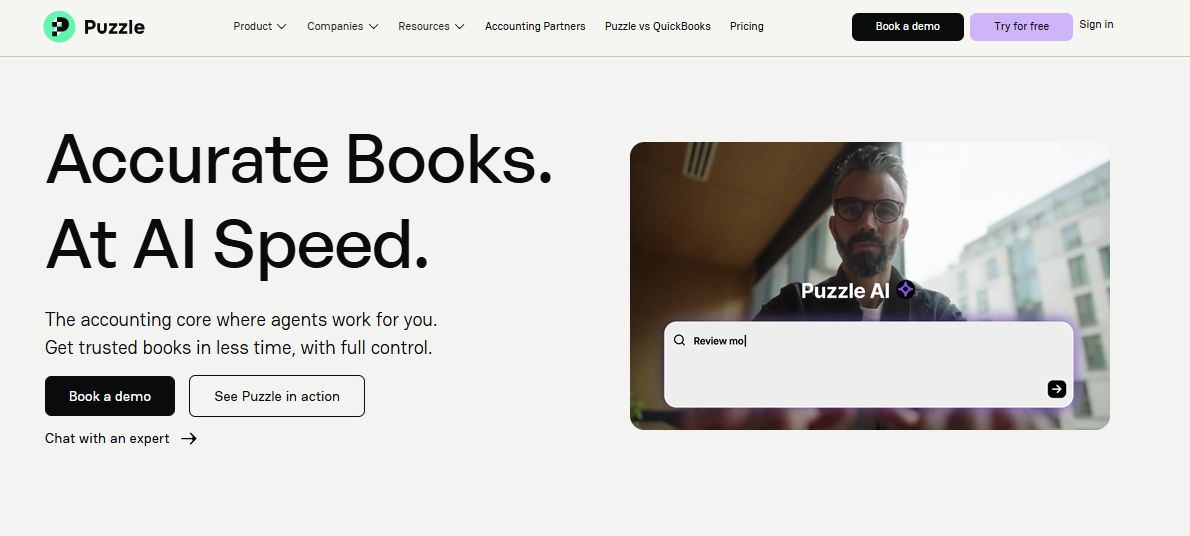
Platforms like Puzzle fall here, and it’s a useful illustration of how all the pieces fit together. It connects natively with the tools many startups already run on, including Stripe, Mercury, Brex, Ramp, Gusto, and Deel, so transaction detail arrives with its context intact. It maintains cash-basis and accrual-basis books at the same time, which lets founders watch daily cash movement while keeping accrual financials ready for investors and lenders. Burn is calculated from net cash outflow and runway from current cash over average burn, both updating as transactions post. Entries the system isn’t confident about go to a review queue rather than straight into the books, which keeps an accountant or fractional CFO in control of what gets recorded.
However, these platforms are built primarily around software and services companies with a digital-first money stack. A business carrying significant inventory, running physical operations, or cleaning up years of messy history may find a traditional ledger with hands-on accounting support to be a better fit.
How to Decide What Fits Your Business
The right choice depends less on features and more on how your business moves money and who will be responsible for the numbers.
Start with where your transactions originate. If most of your revenue comes through a payment processor and most of your spending runs through a modern business bank and corporate cards, a platform with native connections to those systems will get you closer to real time than any amount of manual effort. If you rely on checks, cash, and a traditional bank, the advantage shrinks considerably.
Next, look at your revenue model. Subscription and contract businesses need revenue recognition handled correctly, because cash received and revenue earned can diverge sharply. A tool that keeps both views side-by-side saves a great deal of reconciliation later, especially when investors or a lender start asking for accrual statements.
Then, finally, consider who will review the books. Automation reduces the workload, but it doesn’t remove the need for judgment. Whether it’s an in-house controller, a fractional CFO, or an outside accountant, someone should be looking at flagged transactions weekly. The best setups are the ones where that review takes minutes rather than days.
Finally, be honest about operational complexity. Inventory, job costing, multiple entities, and industry-specific requirements still favor established platforms with deep accountant support. Speed is valuable, but not if the tool can’t model how your business actually works.

Making the Numbers Work for You
Real-time financial insights for small business, while previously impossible, are quickly becoming the floor from which every founder should work. The upside is clear: closing the distance between when something happens in your business and when you understand what it means. For a founder managing a finite runway, that distance is measured in weeks of cash, and shortening it is one of the most practical improvements you can make.
The tools to do it now exist at every price point. Businesses with a modern fintech stack and a need for daily clarity on burn and runway will find the AI-native platforms hard to beat. Those with heavier operational demands can still get most of the benefit by tightening their reconciliation cadence and pairing a traditional ledger with capable outside help. Either way, the goal is the same: making decisions with this week’s numbers rather than last month’s.