
Most founders don’t really choose their first accounting system; they inherit it from whatever the bookkeeper already knew. The ones who do choose one typically choose whatever is cheapest to hit the ground running with on Day 1.
For a while, these are good decisions — both of them are better than using an Excel spreadsheet, after all. In fact, all an early-stage company really needs is a general ledger that categorizes transactions, produces a P&L, and hands something usable to a tax preparer in March. Nearly any entry-level tool clears that bar.
The trouble is that when you do outgrow these tools, it never announces itself. It shows up as a slow accumulation of workarounds: a new tab on this workbook, a manual schedule there, a close that quietly stretched from five days to fifteen. By the time the mismatch is undeniable, it usually surfaces during diligence, an audit, or a board meeting where a number can’t be defended.
So, When Should a Startup Switch Accounting Software?
The Bottom Line Up Front
Switch when the gap between what your system records and what your stakeholders require has to be closed by hand every single month. Make the move at a clean reporting boundary — well ahead of the event that will force it, rather than in reaction to one. The signal is complexity, not revenue, and using a system that automates as much as possible can help keep a headache like this from rearing its head again.
Red Flags That Suggest It’s Time To Switch

Revenue is a tempting metric to make the decision by because it’s easy to measure. But there are companies well past $100 million running comfortably on entry-level software because their business model is simple: one entity, one currency, point-in-time revenue, and no inventory. At the same time, there are $3 million SaaS companies whose books are already unmanageable because they have annual prepaid contracts, usage-based overages, a U.K. subsidiary, and a lender who wants covenant compliance calculated on a GAAP basis.
What actually breaks a starter system is the shape of the business: obligations that get satisfied over time rather than at a point in time, transactions that need to be sliced by dimension rather than by account, and structures that require consolidation. Each of those introduces a class of entry the tool either can’t originate or can only originate one transaction at a time, manually, forever.
The most reliable diagnostic tool is what I call “The Shadow Ledger.”
Ask a simple question: Can the numbers in your board deck be produced from the accounting system without a spreadsheet in between? If the answer is no because deferred revenue lives in a workbook, or because ARR is reconstructed from the billing platform, then the spreadsheet is your accounting system. And it’s the version with no audit trail, no user permissions, no version control, and one person who understands the formulas.
Close creep is the second signal, and it’s the more useful one since it’s easy to measure. Track days-to-close over a rolling twelve months. If it’s lengthening while transaction volume is flat, the added time isn’t added work… it’s translation. Your team is converting what the system produced into what the business needed to prep financials, and that gap only widens over time as complexity grows.
Not being able to answer questions speedily is the third flag. What is our gross margin by product line? What is our deferred revenue roll-forward? What is our cash burn by function? If those take a week to answer, the system isn’t structured for how you now run the company.
The fourth and most consequential flag is accounting requirements the tool was never built to carry. Revenue recognition under ASC 606 requires identifying performance obligations, allocating transaction price, and recognizing revenue as obligations are satisfied.
A tool that records an invoice as revenue on the invoice date can’t do that natively; someone has to maintain the schedule externally and post the entries. The same is true for lease accounting under ASC 842, capitalized software, prepaid amortization, and accrued liabilities that need cutoff discipline rather than cash timing.
Separating Outgrowing the Tool From Outgrowing The Process

A meaningful share of what looks like a software limitation is really a chart of accounts that grew by accretion, a process no one enforces, or a bookkeeper who was scoped for data entry and is now being asked to do technical accounting. Migrating that to a more powerful platform doesn’t fix it; it reproduces the same problems in a system that costs more, takes longer to close, and now requires an implementation partner.
Ask yourself, could a competent controller (given the current system and no new software) produce what you need within a reasonable close window? If yes, you have a process and staffing problem wearing a software costume. Fix that first because you’ll need it fixed regardless — a migration inherits whatever discipline you had going in.
If the answer is no, if the requirement is genuinely beyond what the platform can originate, then you have a real switching decision.
When to Make the Jump, and How to Time It

First, cut over at a reporting boundary. Fiscal year-end is cleanest: You close the old system, carry balances forward, and the new system owns a full comparable year. A quarter boundary is the solid second choice, and month-end is the floor. Mid-period cutovers create a year where every annual report has to be stitched from two sources, and that stitching tends to outlive the people who understand it.
Second, work backward from the forcing event, not toward it. If an audit or a raise is twelve months out, you want at least two clean closes completed in the new system before anyone external looks at it — migrations reveal problems on the first close and resolve them on the second. Discovering an opening balance error while an auditor is in the file is a materially worse experience than discovering it in a quiet month.
Third, give the calendar more room than feels necessary. In my experience, most CFOs underestimated how long it takes to move financial processes to an enterprise-grade system. Assume the same about your own estimate, and avoid stacking the migration on top of year-end close, tax season, a fundraise, or a simultaneous change to payroll or billing. It’s a total nightmare at that point.
The right moment to switch is while things still mostly work. Once the system has genuinely broken, you’re migrating under deadline pressure with degraded data, which is how migrations go badly.
Choosing Where You’re Moving To

Right-sizing matters more than picking a winner here, and the most common expensive mistake is overshooting. Buying an ERP with a six-figure implementation because the company needed accrual revenue schedules and departmental reporting is overkill.
Think in three tiers. The first is stay and add rigor: Keep the current ledger, clean the chart of accounts, add dimensions, and bring in controller-level support. This is the right answer more often than vendors will tell you, and it’s the right answer for anything that turned out to be a process problem.
The second tier is where most growing startups actually land: an accrual-native platform that connects directly to the modern finance stack and produces GAAP financials without a spreadsheet layer.
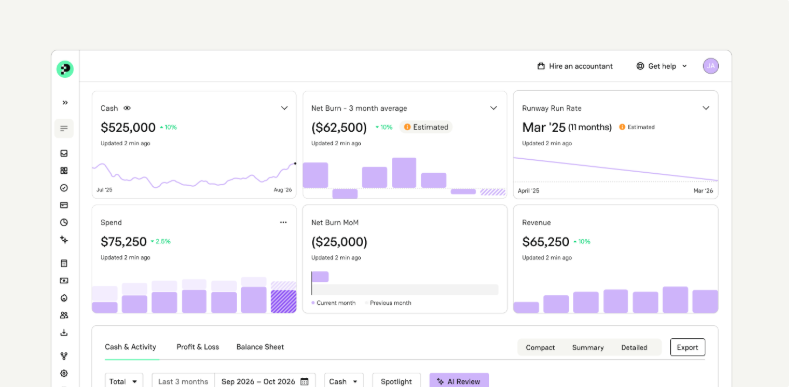
This category has changed meaningfully in the last few years. Tools built for it maintain GAAP-compliant treatment for deferred revenue, prepaid expenses, and receivables without requiring manual journal entries, and pull data natively from banking, card, payroll, and payment platforms rather than through CSV uploads. For example, Puzzle was built around the startup stack and maintains both cash and accrual views from the same underlying ledger, so runway can be managed in a cash view while investor-facing financials stay on accrual.
Anything in this tier should still be evaluated against the specifics: multi-currency support, entity handling, depth of revenue configuration, and how much of your existing stack connects natively.
The third tier is full cloud ERP. That’s the right destination when inventory, manufacturing, multi-warehouse operations, complex intercompany structures, or serious operational workflow are the drivers, not when reporting alone is. Be prepared to rebuild financials from scratch and hire some expensive consultants, because this is genuinely an uphill battle at this point.
What a Clean Migration Looks Like
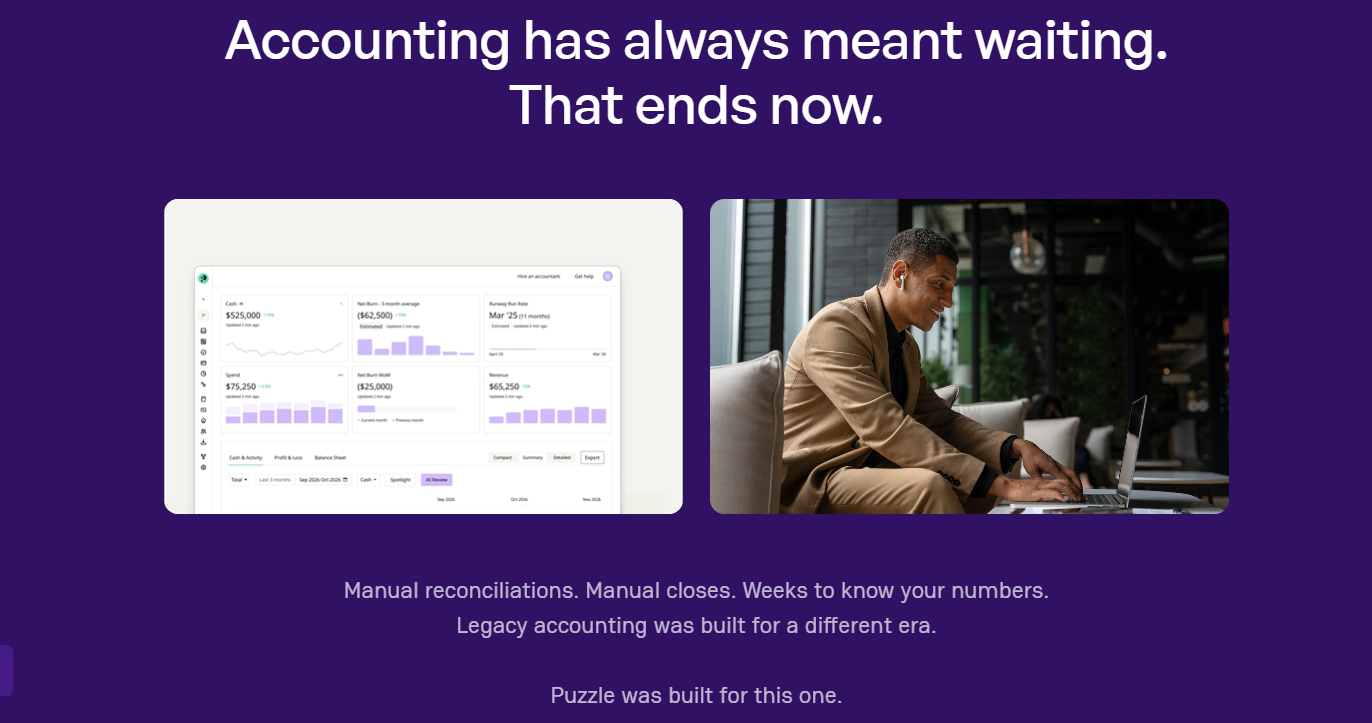
Redesign the chart of accounts before you export anything; a migration is the only cheap opportunity you’ll get to fix it, and every subsequent import depends on it being right. Reconcile every bank, card, and clearing account through the cutover date so nothing arrives in limbo. Load opening balances and tie the trial balance to the prior system to the penny, because if the opening balances are wrong, every statement the new system produces is wrong. Recreate open AR and AP so aging stays intact. An autonomous ledger like the one in Puzzle can help streamline AR and AP migration, and keep it up to date from henceforth.
Then, run it in parallel with your existing setup. Four to six weeks of both systems, with weekly comparison of trial balance, AR aging, AP aging, and bank reconciliations, is the single safeguard that catches mapping errors before they compound. It also allows you to familiarize yourself with the system.
Set a hard cutover date at the end of it, because parallel runs left open-ended never close. Also, document the mapping decisions, exceptions, and manual adjustments while they’re fresh — that file is what an auditor will ask for, and what the next person to touch the books will need.
Finally, decide how long the legacy system stays accessible. You rarely need a decade of transaction detail in the new platform; opening balances plus two or three years of history is usually sufficient, with the archive retained for reference and retention requirements.
Getting the Timing Right for Switching to a Full-Fledged Setup
The question to ask yourself is whether your accounting has stopped being a byproduct of running the business and has started being an input to decisions about it. That shift is what makes the tooling matter. Once investors, lenders, auditors, and your own hiring plan are consuming the numbers, a system that requires manual translation every month isn’t just inefficient; it’s a control weakness with a spreadsheet at the center of it.
Watch the shadow ledger, watch days-to-close, and be honest about whether the constraint is the platform or the process. Then, move at a clean boundary, with enough runway to get two closes behind you before anyone outside is looking.
Done that way, switching is a quarter of concentrated work. Done reactively, it becomes the reason a fundraising round slipped.