
You probably started a company because you were excited about an idea worth chasing. You probably weren’t looking forward to the 90-day wake-up call that comes with an EIN, a franchise tax notice, a contractor who needs payment immediately, and a spreadsheet you have already lied to twice about your burn rate.
The good news is that the finance stack for a pre-seed company in 2026 is easier to stand up than it was five years ago. In fact, it could realistically be built out in a day or two.
The bad news is that there are 40 vendors competing to sell you the same things. So let’s take a broader, more informational look at how the layers fit together, what order to acquire them in, and which decisions matter before you have revenue.
The Bottom Line Up Front

Pick a bank, a card, a payroll provider, and an accounting ledger that all speak to each other (in that order), and wire them together in week one. Keep accrual books from the first transaction even though you don’t need them yet. Spend under $200 a month total on the total software stack. Don’t hire a bookkeeper (you don’t need one yet), don’t buy an FP&A tool, and don’t build a financial model in a spreadsheet you will abandon later. Your entire goal at this stage is a clean, continuous record of where the money went because that record is what your seed investors, tax preparer, and future controller will all be reading.
The First Layer: The Bank Account

Everything downstream depends on this. Your business bank account is the source of truth that every other tool reconciles against, so the two things that matter are clean data out (a real API or a reliable Plaid connection) and enough deposit protection that you’re not thinking about it.
In my experience, Mercury and Brex are the default answers for venture-track companies, and both have free tiers. Mercury sweeps across partner banks for coverage well beyond the standard $250,000 FDIC limit, while Brex offers similar protection through its own vault product and bundles cards and expense management natively (neither is itself a bank, but the insurance passes through their partner banks). Rho is the more treasury-forward option and tends to make more sense once you’re past a Series A.
Any of these will do at pre-seed. What matters far more than the choice is the discipline: one business account, opened the week you incorporate, with no personal spending on it, ever. This sounds obvious, but founders get this wrong all the time. Commingling is the number one reason early-stage books take weeks to clean up later, and it’s the fastest way to weaken the corporate liability shield that you paid a lawyer to create.
The Second Layer: Cards and Spend

From the get-go, you’ll want a corporate card, per-employee virtual cards, and automated receipt capture. Not because you’re spending much yet, but because receipt discipline is a habit that’s nearly impossible to retrofit.
Brex and Ramp both offer this at no cost and both push clean, categorized transaction data into accounting systems. Ramp in particular has become the reflex answer for spend management, and the software is free because the interchange pays for it.
Issue a separate virtual card per vendor category: for example, SaaS subscriptions, cloud hosting, and contractors. When you cancel a tool six months from now, you kill the card, and you never have the “why are we still paying for this” conversation.
The Third Layer: Payroll and Contractors
The moment you pay yourself or anyone else, you need real payroll. Not Venmo, not an invoice from your own LLC, not a Zelle, not a Cash App, and not a check.
Gusto is the standard pick for a small U.S. team and is priced accordingly. Rippling makes more sense if you expect to scale headcount quickly and want HR and device management in the same system. Deel is the answer for international contractors, which most pre-seed companies have at least one of.
Payroll is also where your R&D tax credit begins. If your engineers are building something technologically novel (and at pre-seed, they usually are), a qualified small business can apply up to $500,000 of R&D credits against employer Social Security and Medicare taxes.
That’s serious cash back into a company with no revenue, even though it arrives as a payroll tax offset in the quarters after you file and not the year you spend the money. However, it requires that someone was tracking which payroll dollars went to qualified activities, which is a documentation problem you solve by categorizing correctly from month one — not by reconstructing it in April.
The Fourth Layer: The Ledger

This is the layer that founders skip, but it’s also the most important. Bank feeds, card transactions, and payroll runs are raw data; the ledger is what turns them into financial statements someone else can read.
QuickBooks Online is the incumbent here and is certainly a solid choice if you’re going to hand the books to a traditional local accountant. It does not, however, excel for SaaS companies, where deferred revenue and subscription rev rec mean constant manual entries. Xero is a reasonable alternative with a cleaner interface, but it has a similar problem.
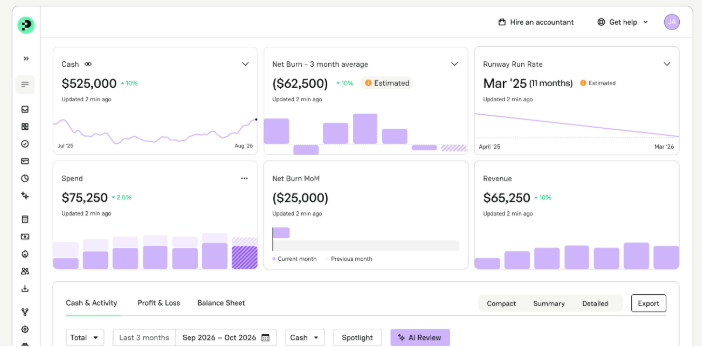
The ones that are built specifically for early-stage venture-backed companies are where I’d look first. Puzzle is probably the most established of these and connects natively to the stack above: Mercury, Brex, Ramp, Rho, Gusto, Rippling, Deel, Stripe. It maintains accrual books automatically rather than as a year-end conversion project, and it surfaces burn and runway as a byproduct of the bookkeeping instead of as a separate spreadsheet.
Don’t Forget the Paperwork That Has a Time Limit

Besides all the software, let’s cover three of the most important deadlines that don’t care how busy you are. They’re even less sexy than number-crunching software, but they’re just as important.
The 83(b) election is the big one. If your founder stock vests, you have 30 days from the grant date to file, and the IRS has been firm that the window is rigid. A missed election is the single most expensive administrative mistake a founder can make. File it, keep the confirmation, and give a copy to the company.
Second, Delaware franchise tax is due March 1 every year for C-corps (most SaaS companies incorporate there and will be subject to this). Delaware bills you by default using the authorized shares method, which is why founders with a normal 10 or 20 million share authorization open an envelope showing a five-figure or six-figure number and have a heart attack. Recalculate using the assumed par value capital method, which has a $400 minimum plus a $50 annual report fee and is almost always the right answer for an early-stage company with just a few assets.
Finally, your cap table should live in software from the first grant. A cap table maintained in Excel is a cap table that will cost you legal fees during diligence. Carta, Pulley, and Fidelity all handle a pre-seed table fine, and several are free or near-free below a certain shareholder count — though check the fine print on how much you’ve raised, since Carta’s free tier cuts off at $1M.
The Monthly Rhythm

For those completely unfamiliar with the monthly close, here’s my hour-long version:
- Reconcile every bank and card account to zero unexplained transactions.
- Review the categorization your software guessed and fix what it got wrong.
- Book the accruals your software can’t guess: prepaid annual SaaS, unbilled contractor work, deferred revenue.
- Confirm payroll posted correctly.
- Look at three numbers: cash on hand, net burn for the month, and months of runway at trailing three-month average burn.
- Write two sentences to yourself about why the number moved.
That last step is the one that converts bookkeeping into management. You can now answer “how long do we have?” with a number instead of a feeling — on the day an investor asks.
Wrapping Up

The best accounting setup for a pre-seed startup is not the most sophisticated one. It’s the one you can stand up in a day and produces a continuous, trustworthy record without requiring you to think about it more than once a month.
Bank, card, payroll, ledger. Wire them together while the company is small enough that wiring them together is trivial. File the 83(b), calculate Delaware the right way, put the cap table in software. Then, go back to building, and let the system quietly accumulate the record that will make your seed round, first audit, and first real finance hire dramatically easier than they would otherwise be.
You don’t need a bookkeeper, fractional CFO, FP&A platform, or board reporting software… yet. You also don’t need a multi-entity structure unless a lawyer told you to. These are all real needs at Series A but are just pure overhead before that. The one outside professional worth engaging now is a tax preparer who has filed startup returns before, and you engage them before year-end, while they can still change the outcome.
The founders who get this right are not more disciplined than you. They just did it in week one, when it took an afternoon, instead of panicking 18 months later and spending a month trying to fix everything.