
Many entrepreneurs start out by managing their business on their own phone. This can even get a startup through its earliest days. But once customers, potential partners, and new hires start calling, regularly using the same number for both your personal and work life can become problematic.
Using a business phone service can give a startup a dedicated number, a professional calling presence, and, most importantly, tools that a standard personal line can’t offer.
Using a cloud-based VoIP (Voice over Internet Protocol) service also means that startup founders can answer calls on cell phones, laptops, and desk phones without tying the company’s communications to a single person’s device.
There are numerous platforms that offer business telephone solutions, but the right choice depends on factors like how your team communicates, your startup’s projected growth trajectory, and your budget.
The best platforms make it easy to establish a separate business number, route calls correctly, share customer context, and keep the team connected without having you pay for features you’re not going to use.
Key benefits of having a business number
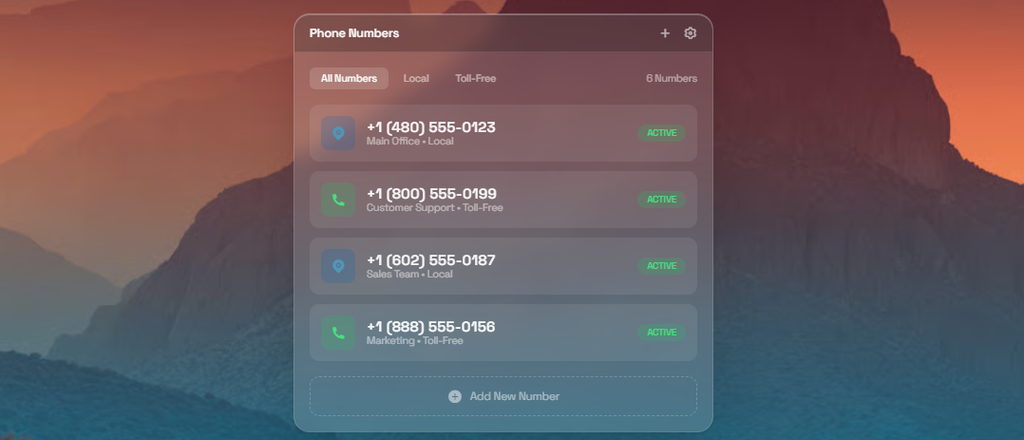
While using a personal number for your startup can be convenient at first, establishing a separate business phone number comes with multiple advantages. These include:
Keeping personal calls separate
This is one of the simplest and most obvious benefits of setting up a dedicated business phone line: separation of your home and work life.
This distinction can be particularly helpful for founders who tend to work irregular business hours, as there’s much less chance that you’ll receive a work-related call when, say, you’re spending quality time with your family.
Most business phone systems support setting work schedules, and can send after-hours calls to a voicemail or an AI answering service. This means every single customer doesn’t have access to your personal number at all times.
Separating personal from business calls can also help smooth the transition if someone leaves the company: customer calls remain attached to the business number, not that of the absent employee or founder, so can be reassigned more easily.
Routing calls to the right person
Generally speaking, a personal phone number is designed to reach one destination. However, the right business phone system can route calls based on time, department, customer needs, or employee availability.
While the technical measures used to do this will depend on your chosen platform and its configuration, for a small startup this normally means that you can, for instance, route sales calls to a founder, billing queries to an operations lead, and support requests to a shared queue.
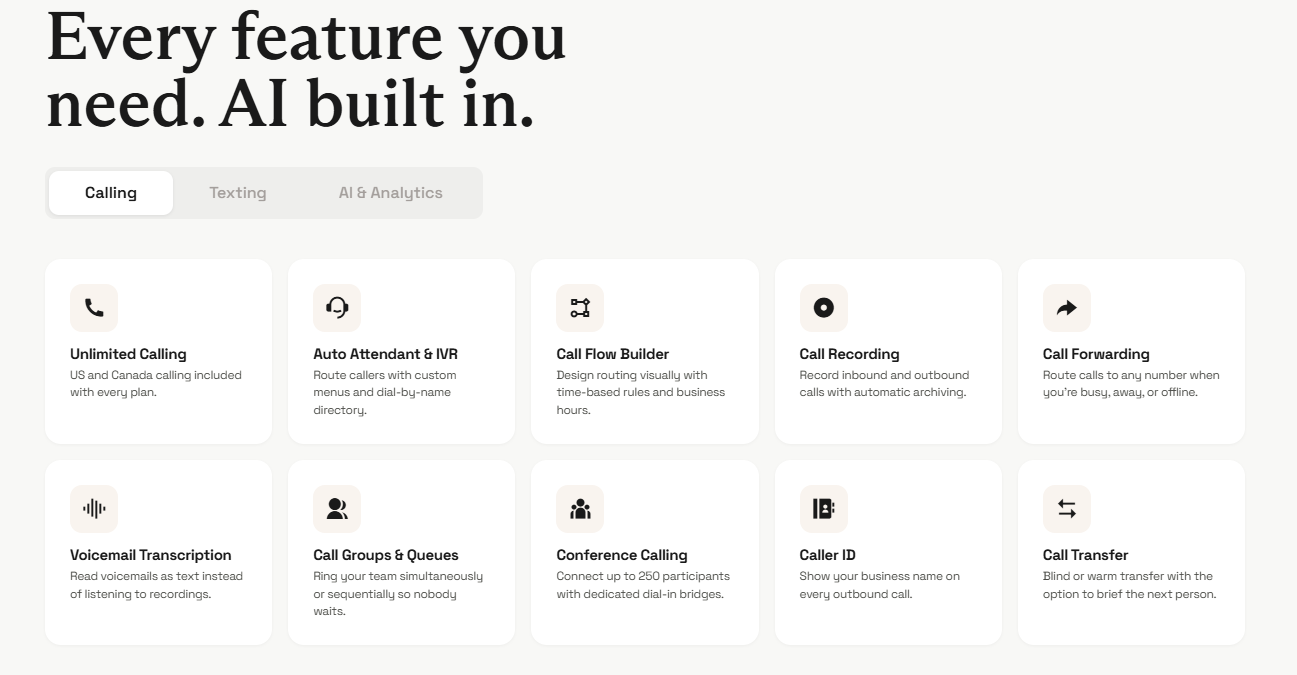
As your company grows, you may also be able to add features like auto attendant, custom greetings, call groups, voicemail transcription, call forwarding, and rules for after-hours coverage.
This can significantly reduce the chance that every caller will try to reach the same very busy person. Done right, the overall result can be a better customer experience without the expense of hiring a dedicated receptionist right away.
Work from everywhere
Modern startups rarely operate only from a single, permanent office at first. A cloud phone service proves useful in these situations, as employees can make business calls using desktop and mobile apps from any location with reliable connectivity, while also preserving the company’s identity.
This kind of consistency matters for setups like hybrid teams, remote workers and founders who may spend part of their day away from their office desk. It also allows employees to more readily access business voicemail, call history, and messages without having to transfer them to their personal devices.
Many modern business phone services combine voice calls with business SMS, team messaging, video meetings, and file sharing. For instance, even some entry-level plans include inbound and outbound voice, as well as call routing, video meetings, SMS, and a mobile app. A startup may not need all of these channels from day one, but this kind of flexibility can be extremely helpful as the business expands.
Creating a shared record
In the scenario we outlined at the start of this guide where a customer calls a founder on their personal telephone number, it’s unlikely that other team members would know what’s discussed unless the founder chose to manually share that information with them.
A business phone system, on the other hand, can create call logs, transcripts, recordings, voicemail notifications, and shared inboxes so that conversations are much easier to track.
This not only improves follow-ups but also reduces the chance of duplicated work. For example, if a founder speaks with a prospect over a business number, then their teammate can read through the call history before responding over text or email. CRM integrations can also help to link customer records to call activity, which will become increasingly important as sales pipelines increase.
The best business phone service for startups: short answer

Of the platforms we’ve reviewed, Nextiva is the best overall business phone service for most startups, as it offers a good balance of price, core communications features, ease of use, and room to scale.
Its entry-level ‘Core’ plan starts at $15 per user per month (paid annually). This includes unlimited calls, business SMS, team chat, video meetings and screen sharing, call routing, and voicemail transcription.
This feature set, even on the lowest-cost tier, is likely one reason why Nextiva has consistently received positive online reviews. For instance it currently holds a rating of 4.5/5 on G2 based on over 3,600 reviews.
G2 reviewers also consistently praise how easy Nextiva is to use and how well integrated certain features are like voicemail and call management.
This said, not every startup will need to use all of these immediately, and some reviewers reported issues with contacting customer support. Read on to find a more detailed review of Nextiva and why other platforms may be a better fit for startups in certain specific use cases.
Nextiva
- Plans start at just $15 per month with annual billing
- Entry tier includes voice, SMS, team chat, video, and call routing
- Good value for startups that need a unified communications platform
- Per-month billing for the entry tier climbs from $15 to $23 per user.
- Certain advanced features e.g. the AI receptionist are paid add-ons.
- Only available for businesses in the United States.
We chose Nextiva as the overall best solution for a business phone service, as many startups need a complete phone system rather than just a simple calling app.
The above-mentioned ‘Core’ plan covers all essential calling features for most startups, while the mid-tier ‘Engage’ plan ($25/user/month, billed annually) can add more customer-facing features. This includes a more generous SMS allowance (500 vs 100 for ‘Core’), call recording, live chat, and chatbots, which are otherwise only available as an add-on for ‘Core’ subscribers.
The ‘Scale’ plan ($75/user/month, billed annually) adds advanced routing and AI features such as transcription and call summaries, as well as answer assistance.
Structuring its plans in this way means Nextiva offers startups a reasonably straightforward path from basic call handling to more fully-featured customer communications systems.
While some aspects, like the XBert AI Receptionist (see below) have to be purchased separately, the core features that a startup is likely to need aren’t divided across multiple disconnected products.
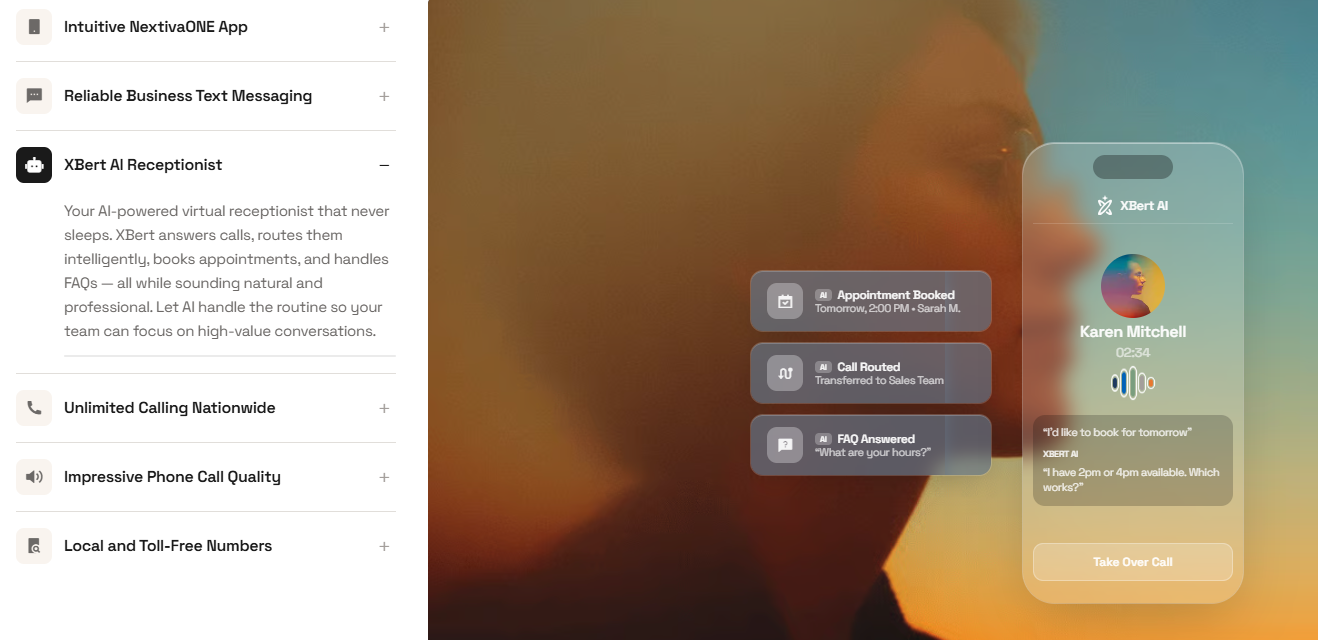
If you need AI support without replacing human staff entirely, XBert can answer calls, text and chats around the clock. It can also collect basic information, qualify leads, book appointments, and escalate conversations to employees according to rules you define. Pricing starts at $99 per month for 100 interactions, with additional interactions costing $0.99 thereafter. This can be very useful for teams that routinely receive the same customer questions and/or want to offer coverage outside normal business hours.
Phone.com
- Good security and compliance for the price
- Straightforward setup makes it a simple option for smaller teams
- Entry tier starts at $15/user/month (billed annually)
- IP phone compatibility only at higher tiers
- SMS features and call recording are add-ons
- Some users report poor customer service
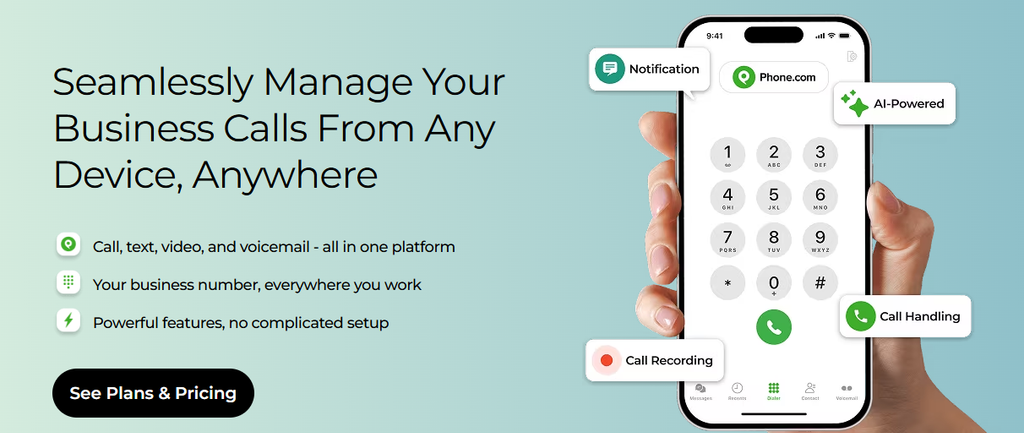
Phone.com is a more basic offering than Nextiva, but it does also offer small savings across all three tiers. Its ‘Basic’ plan is easy to get started with and includes unlimited minutes, mobile and web apps. The standard capabilities you’d expect like auto attendants, hold music, and call transfers are all included too.
HIPAA compliance could make it a good fit for small healthcare teams, but features like two-way texting and after-hours SMS replies are locked behind its ‘Plus’ plan ($22.50/user/month, billed annually). Meanwhile, analytics and data retention only feature on the ‘Pro’ plan, though its pricing ($33/user/month, billed annually) is more modest than many others.
The lack of AI integrations is another gap worth noting, but if you don’t need them, you might find value in their more affordable pricing, and the ease of setup could factor into your decision if you want a business phone in a hurry.
Dialpad
- Entry-level plan costs $15/user/month (billed annually)
- Powerful AI call transcription and call analytics
- Good integration with Google Workspace
- More advanced CRM integrations require higher pricing tiers
- No 24/7 phone support for entry-level plan
- Advanced AI capabilities may not be necessary for small teams
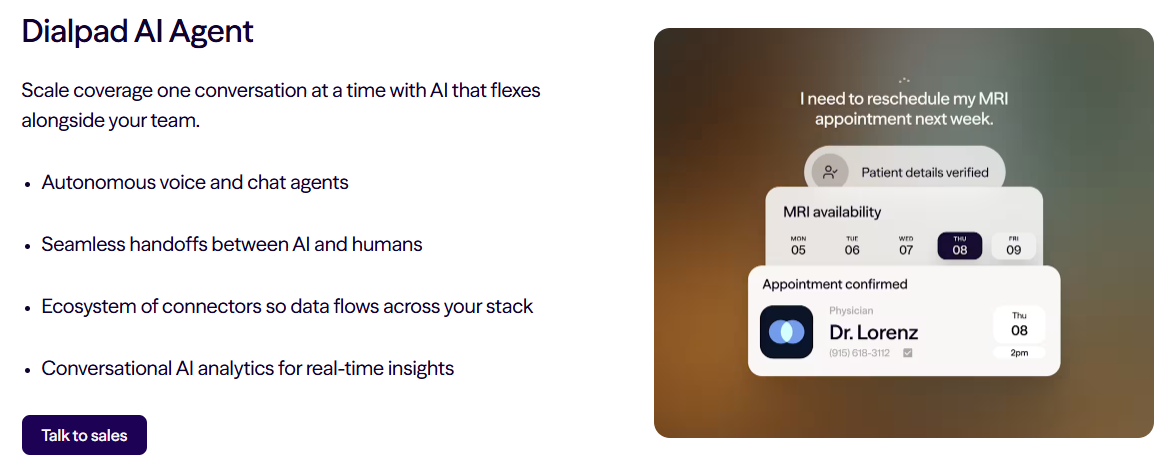
Dialpad can be a good choice for startups that want conversation intelligence from the start.
Its lowest cost ‘Standard’ plan ($15/user/month, billed annually) includes unlimited calling, SMS and MMS, team messaging, video meetings for small groups, call forwarding, real-time call transcriptions, as well as voicemail transcription and real-time analytics and reporting.
This can be helpful for teams that want searchable calls, real-time transcripts, and communication tools that work well with Google Workspace, which is the only supported integration on the ‘Standard’ plan. But startups that need the likes of Salesforce, Teams, and HubSpot will need to sign up for at least a ‘Pro’ plan ($25/user/month, billed annually).
This means that while Dialpad can offer more AI value compared to some entry-level business phone services, it doesn’t automatically offer the best value to startups that don’t need these features.
JustCall
- Extensive CRM/help desk integrations
- Strong calling, SMS, dialer, and automation tools for sales teams
- Local numbers support calling across multiple countries
- Relatively high entry-level pricing
- Minimum two seats
- More advanced AI/outbound features require higher pricing tiers
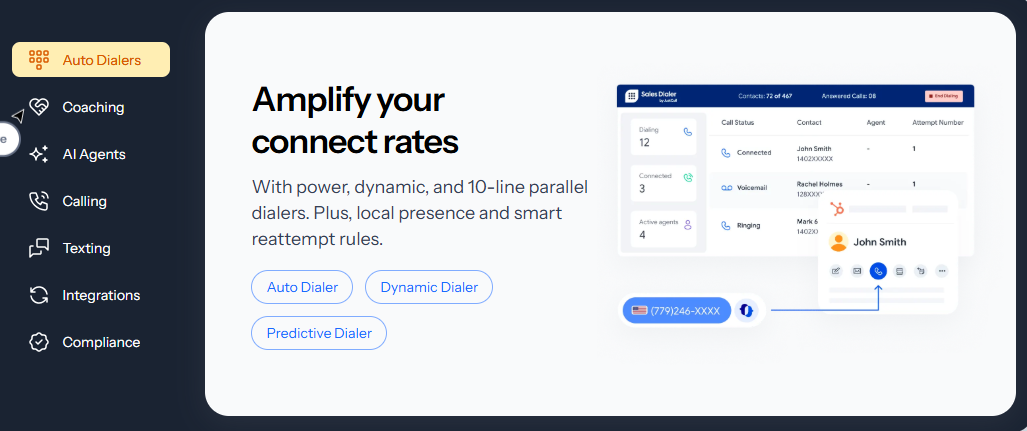
JustCall is a natural fit for startups that rely heavily on outbound sales teams or significant CRM use.
Its entry-level ‘Team’ plan ($29/user/month, billed annually) includes unlimited inbound and outbound minutes, SMS, IVR, analytics, more than 100 integrations, and local numbers in over 70 countries. Higher-priced tiers add a power dialer, support for bulk SMS campaigns, advanced analytics and reporting and real-time agent assistance.
The trade-off is cost. Even the lowest-priced tier requires a minimum of two licenses, meaning a startup has to pay at least $58 per month before considering add-ons like AI review assist and SMS bundles. This might be acceptable for a sales-focused team that needs powerful integration and dialing features. But it’s much harder to justify for a founder who only needs, say, a professional number, shared calling, and basic customer messaging.
Choosing the best business phone service for your startup
We stand by our assessment that Nextiva is the best overall business phone service for startups. It combines accessible pricing, with a broad set of communication tools that are likely to be useful to newer companies, as well as a clear upgrade path.
RingCentral can be a good alternative for startups that know they’re going to need a more expansive communications suite along with relatively complex requirements as they scale. Dialpad may be a good fit for startups that know they’ll need to prioritize AI transcription from day one, as well as real-time call insights. JustCall might make more sense for sales-led startups that need deep CRM connections, powerful dialing tools, and international numbers.
A dedicated business number is just the beginning. The right choice of platform will always come down to how your chosen provider handles your real-world calls, messages, customer information, and workflows. That means the best business phone service is one that not only provides a solid customer experience now, but also supports the way your team works as it grows.