
Burn rate and runway are the two numbers a founder gets asked about in every board meeting, every investor update, and every internal debate over whether the next hire can wait. They’re also the two numbers most likely to be wrong. Not because the formulas are difficult, but because the inputs aren’t what people assume they are.
The arithmetic takes thirty seconds; the real work is knowing which cash movements belong in the calculation, which ones distort it, and how to keep the answer current when the underlying figure shifts every time payroll runs, a vendor invoice clears, or a customer pays weeks late. This guide will break down How to Calculate Burn Rate and Runway.
Start with Gross Burn

There are two versions of burn rate, and gross is the one to start with. Gross burn is every dollar of operating cash that leaves the business in a period, before any offset for money coming in.
This is the one number that’s hardest to argue with: payroll, contractors, rent, cloud infrastructure, software subscriptions, legal, insurance, marketing spend, travel, etc. Basically, if it left the bank account to keep the company running, it counts.
Say a company’s operating outflows for the month total $520,000. That’s the gross burn. No adjustment for the $180,000 that came in from customers, no netting, and no interpretation.
The reason to calculate this separately is that gross burn is your exposure if revenue goes to zero. It answers a question that net burn can’t: If your two largest customers ceased to exist tomorrow, how fast would the company consume cash? Early-stage teams with concentrated revenue sometimes discover that their comfortable net burn is masking a gross burn they’d have no ability to survive. Investors ask for both figures for exactly this reason.
Net Burn: What You’re Actually Consuming

Net burn takes gross burn and credits back the cash that came in from customers over the same period. It’s the figure most people mean when they say “burn rate,” and it’s the one that runway is built on.
Net burn = cash operating outflows − cash operating inflows
With $520,000 out and $180,000 collected, net burn is $340,000 for the month.
The word doing the heavy lifting there is “collected,” not booked, invoiced, or recognized. If you billed $240,000 and collected $180,000, your net burn is built on the $180,000, because the other $60,000 is sitting in accounts receivable and cannot pay anyone’s salary. This is the single most common error in a founder-built burn model, and it runs in a predictable direction: It makes the company look healthier than it is, right up until a large receivable ages past 90 days.
The same discipline applies on the outflow side as well. An accrued expense you haven’t paid yet doesn’t reduce cash this month — but it will, and it belongs in your forward view even though it’s absent from your historical burn.
Runway: Converting Burn into Time
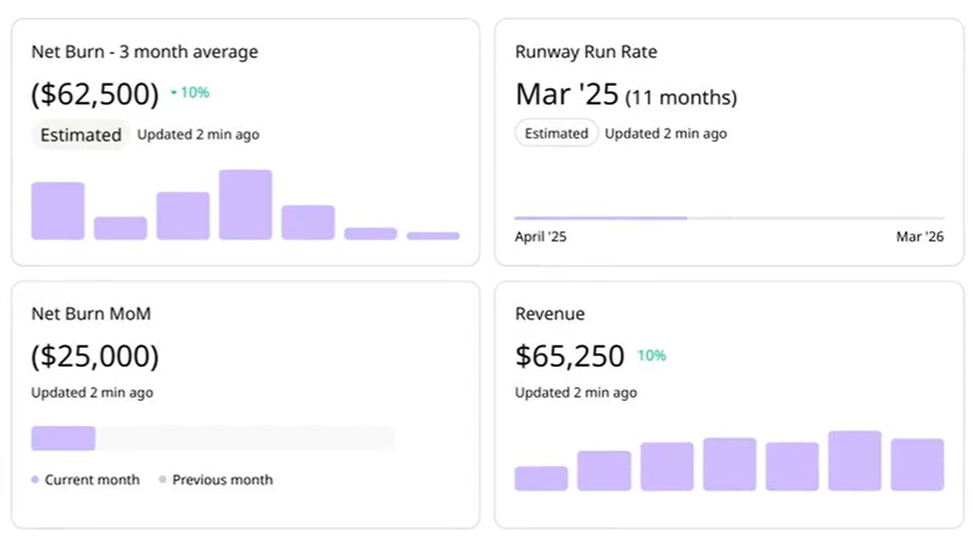
Once you have net burn, runway is a matter of asking how many months of it your bank balance covers.
Runway = cash on hand ÷ net burn
So, with $4,100,000 in the bank and a $340,000 net burn, runway is roughly 12.1 months.
While accurate, that figure is somewhat misleading. A single division assumes your burn stays flat, but it never does. Companies hire, sign bigger cloud commitments, and increase marketing spend precisely during the period they’re measuring.
Suppose that same company has three engineers starting in month four and two more in month seven, pushing net burn to $420,000 and then $480,000. A month-by-month cash roll-forward tells a different story.
Here’s a quick example:
| Month | Net burn | Ending cash |
| 1 | $340,000 | $3,760,000 |
| 3 | $355,000 | $3,065,000 |
| 4 | $420,000 | $2,645,000 |
| 6 | $420,000 | $1,805,000 |
| 7 | $480,000 | $1,325,000 |
| 9 | $480,000 | $365,000 |
Cash runs out during month ten, but the static calculation said twelve months. That two-month gap is the difference between running a fundraising process and running a rushed one — or, even worse, missing a payroll period.
Use the simple division for a fast read, but use a roll-forward for any decision that actually matters, such as a hiring plan, a lease commitment, or a fundraise timeline.
The Inputs That Muddy the Water

Beyond billed-versus-collected, a handful of items reliably distort burn calculations.
One-Time Items in Both Directions
An annual D&O insurance premium of $60,000 paid in March makes the month look catastrophic. A $250,000 pilot payment from an enterprise customer makes it look like you’ve reached breakeven. Neither reflects your operating rhythm. So pull them out, note them, and calculate a normalized burn alongside the actual. Keep both, because the one-time payments are still real cash you no longer have.
Financing Inflows Treated as Operating
A $5 million Series A landing in your account does not reduce your burn. It increases cash on hand, which extends runway but has nothing to do with how fast you’re consuming money. The same goes for venture debt draws, SAFE proceeds, and R&D tax credit refunds. Mixing these into net burn produces a month that looks profitable and a metric that means nothing.
Payroll Calendar Effects
Biweekly payroll produces three payroll months twice a year. If your burn average happens to include one of those months and your forward projection doesn’t, you’ve built a mismatch into your own model.
Capital Expenditures and Deposits
Cash spent on equipment, security deposits, or capitalized software never hits the income statement as an expense, but it still leaves the bank and it absolutely affects runway. Track it, but track it separately from operating burn so you don’t confuse a one-time buildout with an elevated cost.
Taxes and Owner Distributions
Estimated payments, payroll tax deposits, and any founder draws are cash out the door. But they’re easy to overlook because they don’t feel like operating expenses.
The throughline here is categorization discipline. Burn is only as reliable as the consistency of how transactions get coded, and in a company where a founder is approving expenses between customer calls, that consistency degrades fast. Accounting platforms built for startups can handle this by categorizing transactions against the live bank and card feeds as they post, so the classification work happens continuously instead of accumulating into a month-end cleanup project that has to be finished before anyone can trust the number.
Check Numbers Against the Bank

Before you circulate a burn figure, tie it out. Add up the cash in every operating account at the start of the period, then subtract what’s there at the end. That decline should equal your net burn once you back out anything non-operating that moved through those accounts, like a financing draw or a transfer between accounts.
Beginning cash of $4,440,000 and ending cash of $4,100,000 gives a $340,000 decline, which matches the calculated net burn. If it doesn’t match, something is missing. The usual culprits are a second bank account that no one included, a credit card balance that was paid but not categorized, a transfer between accounts that was double-counted as an outflow, or a financing item that slipped into the operating figures.
This reconciliation takes a few minutes, and it’s the difference between a number you can defend in a board meeting and one you’ll have to walk back. Do it every period, including the periods where you’re confident it’ll tie.
Which Burn Rate to Use

“Burn rate” isn’t one figure, because it depends on which stretch of time you measure. Three versions are commonly used, and each one answers a different question about the business.
- Last month’s burn is the most current but also the most volatile. One large annual payment can swing it by 20%.
- A trailing three-month average smooths the noise and is what most investors expect to see. It’s the default for board reporting.
- Forward projected burn is the most useful for planning and the most honest if you’re growing. If you know headcount is increasing 40% next quarter, a trailing average understates what’s coming.
Pick one, and stay consistent. A runway number without a stated basis invites everyone in the room to assume a different one.
Just don’t treat burn simply as a formula you look up. By the time a typical close finishes with bank recs being done, credit card transactions categorized, and accruals booked, you’re often two or three weeks into the following month. This means the figure you’re reviewing describes a period that ended weeks ago, and you’re making forward decisions on it.
At a 12-month runway, that lag is tolerable. At six months, it isn’t. Runway compresses non-linearly: The same $80,000 increase in monthly burn costs a company with 24 months of runway about four months, and a company with eight months of runway about two, but the second company has far less ability to absorb it. The closer you get to the wall, the more the staleness of your own data costs you.
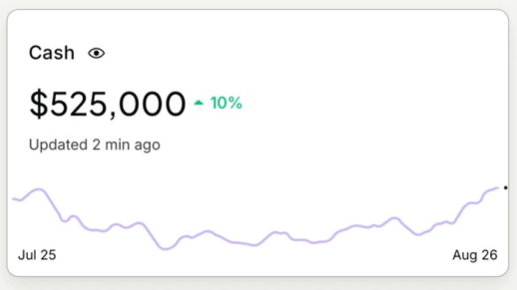
The teams that manage this well stop treating burn as a report and start treating it as a dashboard. That means the underlying ledger has to be current enough to support it with bank and card feeds syncing continuously, transactions categorized on arrival, and burn and runway recalculating off that live data — rather than off a spreadsheet someone updates when they remember to.
This is the specific thing that accounting software like Puzzle is built around: Because the general ledger updates as transactions post, burn and runway are visible on any given day rather than reconstructed after the fact. Whether you get there through a platform or through a genuinely disciplined weekly cadence matters less than getting there, but a manual model rebuilt by hand every month tends to survive about two quarters before it stops being maintained.
What to Do After You Have Your Runway
A runway number tells you what you should commit to. How many months you’re carrying should set how freely you take on new fixed costs — a hire, a lease, an annual contract.
There are roughly three bands:
At 18+ months, you have room to invest ahead of revenue and test things that might not work.
At 12 months, fundraising should be actively planned. Raises take three to six months from first meeting to wire, and running out of runway mid-process destroys your negotiating position more effectively than almost anything else.
At 6 months or less, every incremental commitment, such as a hire, a lease, or an annual contract, needs to be evaluated against whether it extends or shortens the window.
The most valuable version of this practice isn’t calculating burn accurately once. It’s knowing, on any given day, roughly what your runway is without having to go ask anyone. That’s what turns it from a reporting obligation into an operating instinct, and it’s the difference between a founder who reacts to their cash position and one who steers by it.