
For most businesses, the go-to names like Stripe, Square, or PayPal work just fine for processing card payments. While they each have their own unique quirks, a couple characteristics they share are that onboarding is quick and easy, they offer plenty of native software integrations, and their standard transaction fees are flat-rate.
The latter becomes an issue as you grow. Flat-rate pricing makes processing costs easy to calculate, but these types of rates are no longer competitive once you start experiencing real growth. Custom, interchange-plus, or subscription-based models can cut costs significantly.
There’s not a universal cutoff point guiding when to switch, as your average ticket size and card mix can influence this. However, as a general rule of thumb, it may be worth running the numbers once your monthly processing volume hits somewhere between $5,000 and $10,000.
So, where should you turn once you start outgrowing your flat-rate credit card processor? Here are some of my top picks.

Best Credit Card Processors At a Glance
| Best For | Online Card Fee | In-Person Card Fee | Monthly Subscription Fee | |
| Helcim | Volume discounts | Interchange + 0.50% + $0.25, volume discounts available | Interchange + 0.40% + $0.08, volume discounts available | N/A |
| Adyen | Large enterprises | $0.13 + payment method fee (varies) | $0.13 + payment method fee (varies) | N/A |
| Luqra | Growing ecommerce businesses | Custom | Custom | N/A |
| Corepay | Healthcare and specialized industries | Custom | Custom | N/A |
| Finix | API integrations | Interchange + 0% (0.3% for Amex) + $0.15 | Interchange + 0% (0.3% for Amex) + $0.08 | $250 |
| Stax | Subscription-based pricing | Interchange + $0.15 | Interchange + $0.08 | $99–$199+ |
| Payline Data | High-risk merchant accounts | Interchange + 0.50% + $0.20, volume discounts available | Interchange + 0.35% + $0.10, volume discounts available | N/A |
Helcim: Best for Volume Discounts
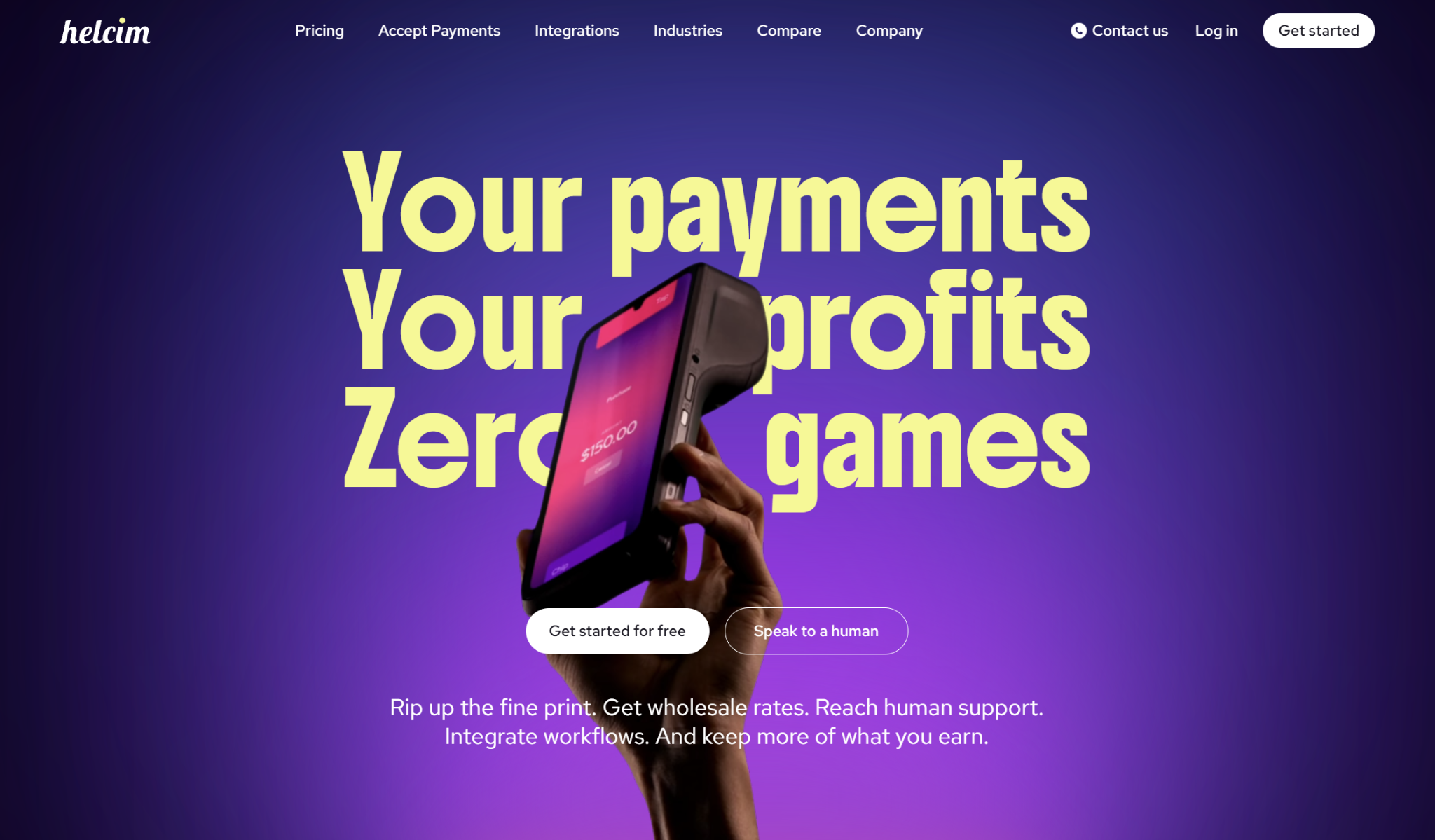
Helcim is one of the most popular interchange-plus card processors out there. It serves businesses in a range of industries and is an appropriate choice for collecting both in-person and online card payments. For in-person processing, Helcim sells a terminal and card reader, and it supports Tap to Pay. For those in ecommerce, Helcim has a no-code solution for creating an online store, or you can use its API for further customization.
It has native integrations with third-party platforms across functions like accounting, billing, project management, CRM, and more. Some of its integrations are industry-specific, such as automotive and healthcare software.
If you encounter any issues, you can contact Helcim’s support team over the phone, or you can submit a support ticket. Note that Helcim isn’t a high-risk processor, so if your business operates in these verticals, you’ll want to look elsewhere.
Pricing
Helcim’s standard card processing rates are:
- Online: Interchange + 0.50% + $0.25
- In-person: Interchange + 0.40% + $0.08
Volume discounts are available. Also, if you prefer to pass card fees onto your customers, Helcim supports surcharging at no cost to you.
Adyen: Best for Large Enterprises
Adyen is geared toward large enterprises over SMBs, so once you really start scaling, it could be worth a look. The Dutch fintech company is known for its strong international focus, as you can use it to accept over 200 payment methods worldwide, and you can set up localized checkout experiences for your customers.
AI is another of its strong suits. Adyen Uplift uses AI to optimize payments, ideally increasing conversions and reducing payment costs. It can personalize the checkout experience, tokenize payment details, help with fraud prevention and authentication, and conduct smart retries for failed payments. Then, there’s Adyen Agentic, which lets you accept payments from AI agents. Customers can complete their entire purchases through leading AI chatbots without having to visit your site directly.
Adyen is also suitable for in-person payment collection though, with the processor selling various countertop, mobile, Tap to Pay, and unattended hardware options.
Pricing
Adyen uses interchange-plus pricing. There’s a fixed $0.13 processing fee, in addition to a payment method fee, which varies. As an example, the payment method fee for Mastercard and Visa is interchange + 0.60%.
Luqra: Best for Growing Ecommerce Businesses
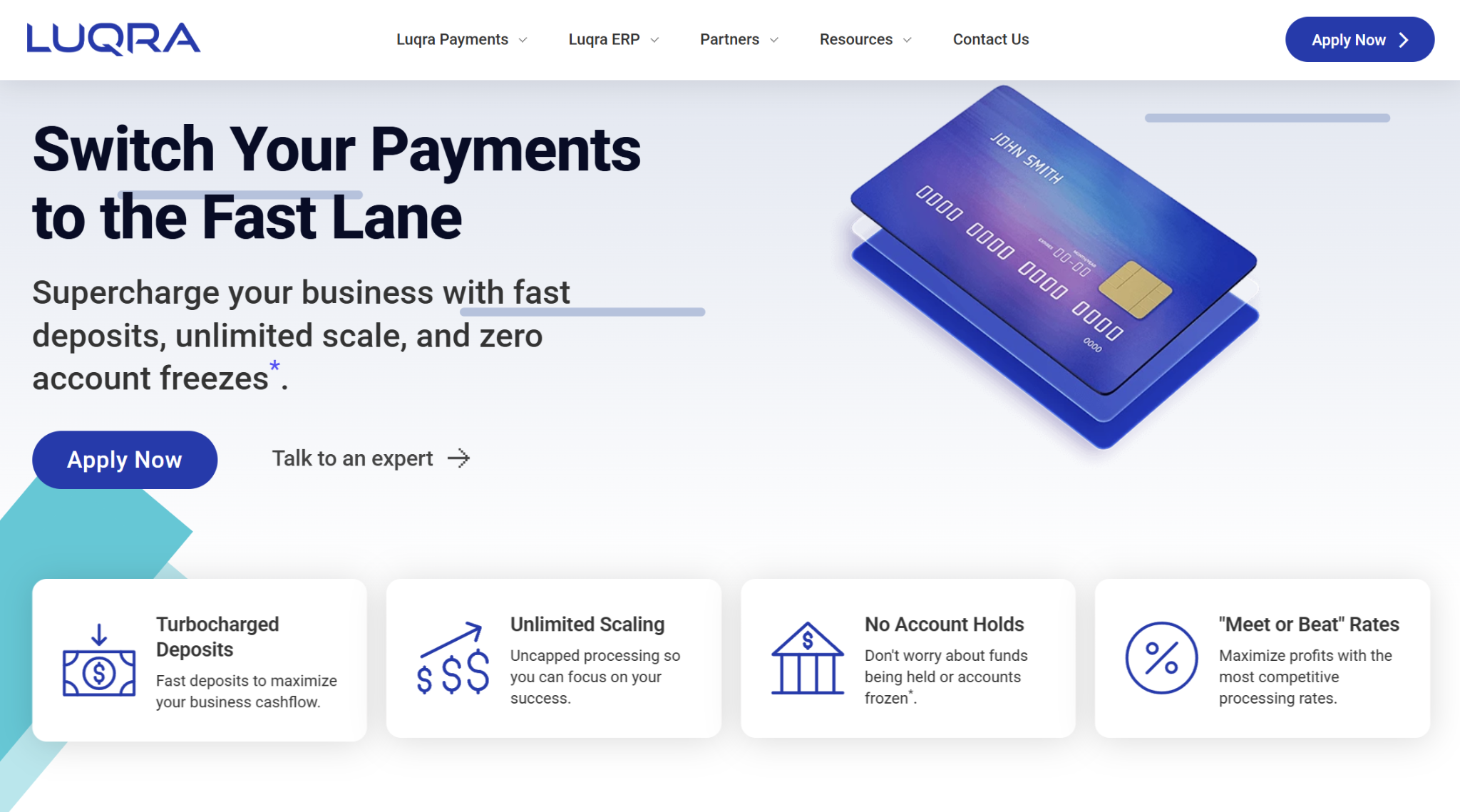
Luqra was designed specifically with ecommerce in mind, although it serves physical businesses as well, selling mobile, countertop, and wireless terminals, in addition to POS systems. Where Luqra diverges from many of the larger names is that it’s friendlier to businesses in certain high-risk industries and those experiencing rapid growth, advertising uncapped processing.
For example, a business that had their account shut down or their funds held by Stripe may not encounter those issues with Luqra. Much of this comes down to Luqra’s approach to payment processing. You’ll undergo in-house underwriting and, if approved, get your own dedicated merchant account. Many mainstream processors don’t give you your own merchant account, relying on algorithms for approval decisions rather than human review.
Because Luqra is a relatively small company, it provides personalized customer service, as you’ll be assigned a success manager. You can also access 24/7/365 phone support.
Pricing
Luqra uses custom rates, supporting flat-rate and interchange-plus pricing. It promotes “meet or beat” rates, which it claims will never increase. If you want to pass card fees onto your customers, you’ll need to enroll in their cash discount program, which comes at a cost of $99 monthly.
Corepay: Best for Healthcare and Specialized Industries
Like Luqra, Corepay is willing to work with merchants at a range of risk levels, including high-risk merchants that mainstream processors won’t serve. Corepay serves several industries, though it has somewhat of a healthcare focus, promoting solutions for med spas, pharmacies, and telemedicine platforms, including those selling peptides and GLP-1s.
In addition, its merchants are spread out across the globe, as Corepay can process payments in 30+ countries and accept 135+ currencies. It also has a niche in processing MOTO (mail order/telephone order) payments, which may be seen as high-risk.
When you apply, you’ll undergo in-house underwriting and will receive your own merchant account upon approval. Corepay prioritizes fast decisions, so you’ll typically receive a pre-approval decision within one business day. Its customer support is also strong, with both phone and email support, and the team assigns an account manager to help with your application.
Pricing
Corepay uses custom pricing, offering both flat-rate and interchange-plus models. The exact fees you’ll face will depend on factors such as your volume and your industry.
Finix: Best for API Integrations
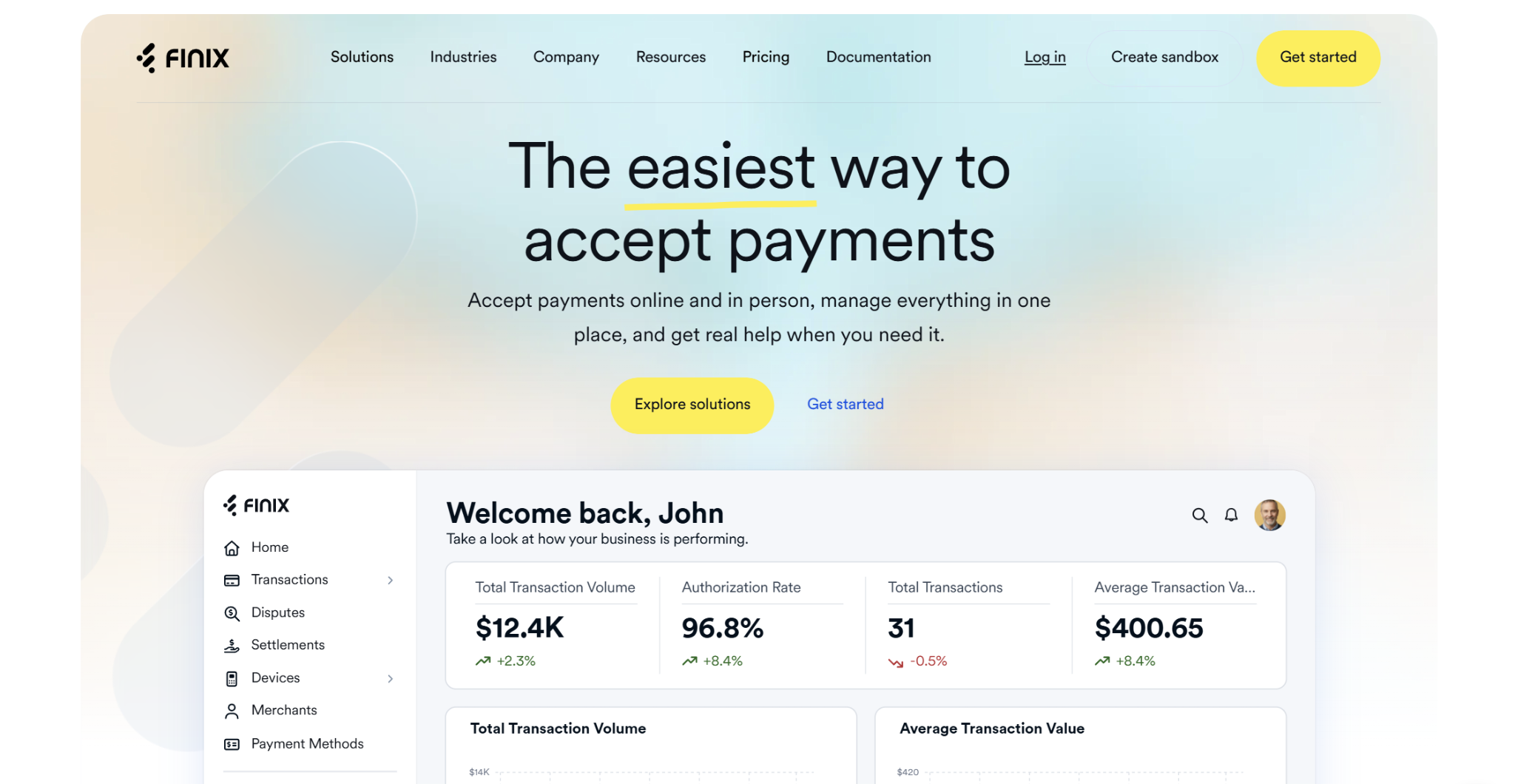
Finix is another processor that works with businesses ranging from low to high risk. Examples of industries it supports are retail, ecommerce, CBD, healthcare, nutraceuticals, supplements, digital wallets, lending, and gaming. If you need to accept credit card payments in-person rather than online, you can do so with one of Finix’s payment terminals, which span from mobile to countertop use.
It has especially strong developer documentation, helping you build integrations for online, in-person, and marketplace payment collection. There’s also an official Finix MCP server, which allows AI agents like Claude and ChatGPT to search through the API and provide you with up-to-date answers. However, there are still low- and no-code alternatives for checkout pages, payment links, invoices, subscriptions, and payment links.
Other advantages of processing card payments with Finix are that you get your own merchant account, and there are no long-term contracts.
Pricing
Finix uses a subscription pricing model. There’s a $250 monthly fee, and in exchange you get low, interchange-plus rates. On top of interchange, the card processing fees are:
- Online: $0.15
- In-person: $0.08
Note that there’s an additional 0.3% charge for American Express cards.
Stax: Best for Subscription-Based Pricing
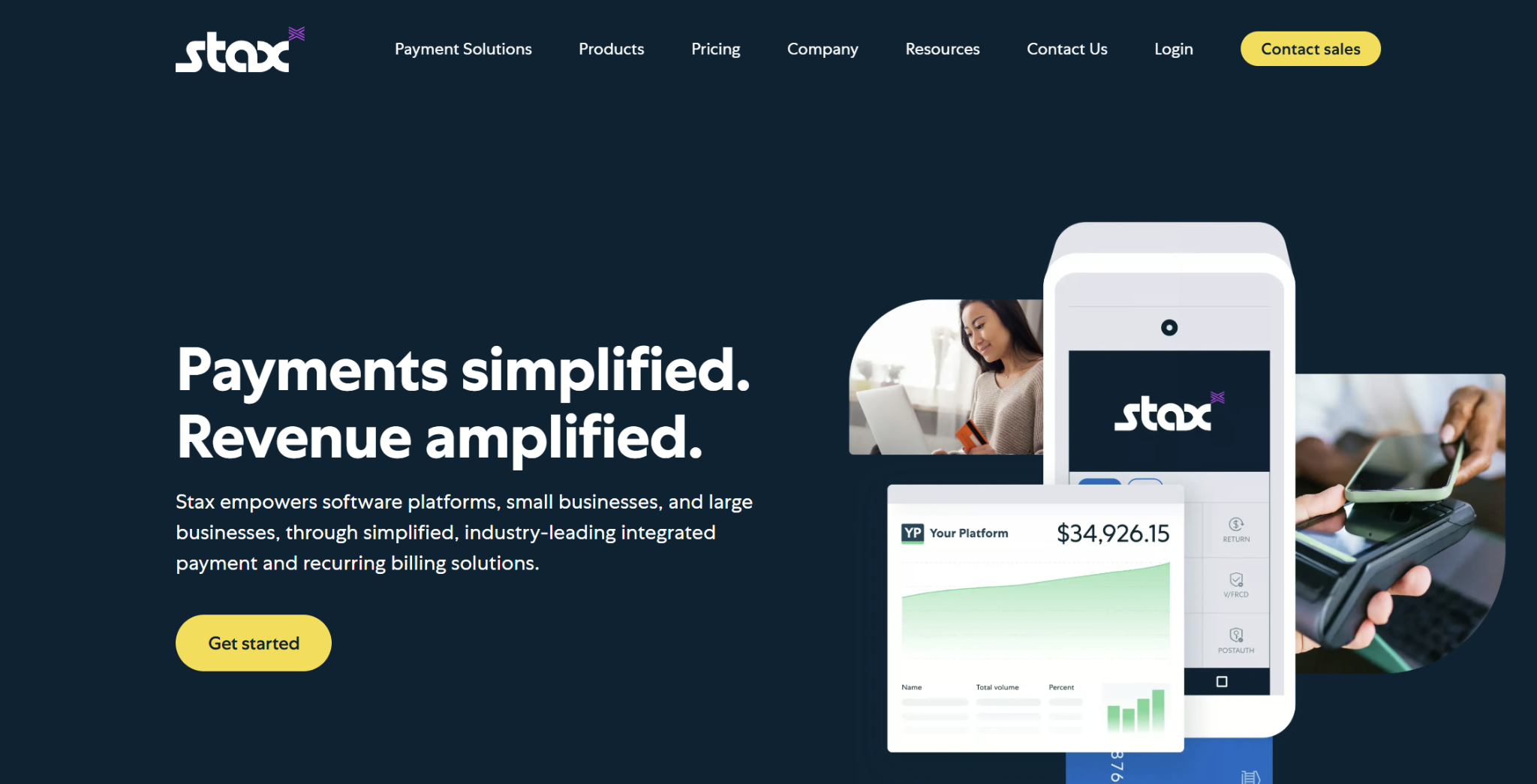
Stax is another favorite among high-volume merchants, although businesses in high-risk industries should look elsewhere. However, for low-risk businesses, it could be a solid fit. Stax has solutions for card-present and online payments, embedded payments, surcharging, and recurring billing. It frequently works with retail (including ecommerce), field service, professional service, and healthcare businesses.
To start accepting payments online quickly, Stax has Lightbox, which is a pre-built, customizable payment page. For in-person processing, Stax sells a mobile wireless terminal, a countertop terminal, a POS solution, and a couple of mobile card readers. Plus, you can opt for the terminal protection plan, which lets you swap out your devices in case there are defects or other issues.
Beyond straight processing, Stax offers strong analytics capabilities for both physical and online stores, letting you track sales trends through heatmaps, track your inventory, and determine your customer lifetime value.
Pricing
Stax uses a subscription pricing model, which is similar in nature to Finix. You’ll pay a monthly fee, ranging from $99 to over $199, depending on your annual sales volume. Otherwise, Stax uses interchange-plus pricing. You’ll pay the following credit card transaction fees on top of interchange:
- Online: $0.15
- In-person: $0.08
Payline Data: Best for High-Risk Merchant Accounts
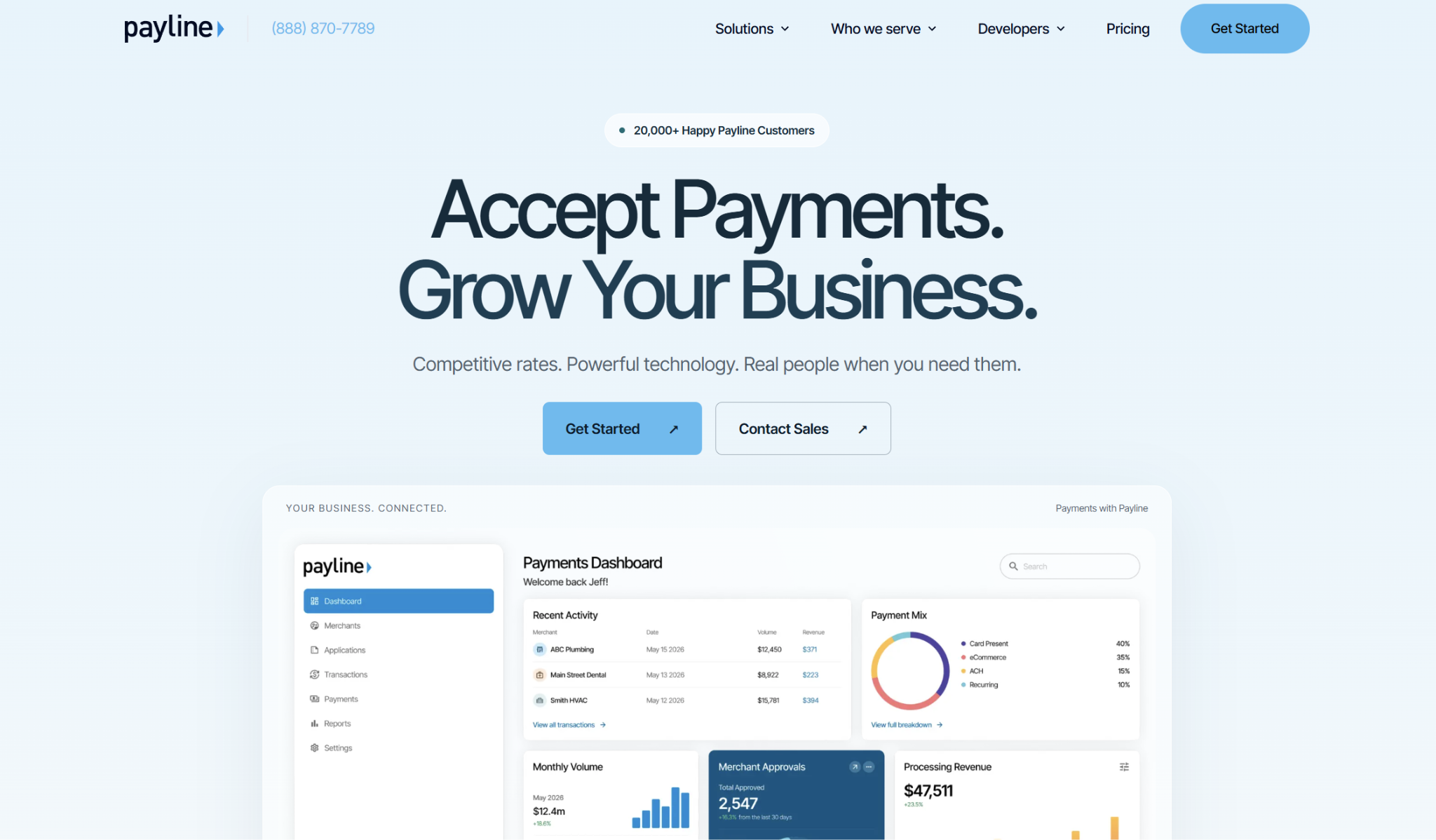
Payline Data works well for many small businesses, both low-risk and high-risk. For high-risk payment processing, some of the verticals it serves are nutraceuticals, supplements, firearms, tobacco, online gaming, and travel. Payline Data’s team works closely with you during the underwriting process, helping you determine which documents you need and answering your questions. If approved, you can access your own merchant account.
Payline Data can process in-person and online card payments. It offers several different types of terminals for in-person payment collection, like handheld, countertop, and wireless terminals, as well as POS systems. To accept online payments, you can use simple options like a hosted payment page or payment links, or you can use its API to build your own custom integrations. There’s also a virtual terminal, which you can use to accept orders over the phone.
Recurring payments are another of Payline Data’s specialties, supporting billing workflows for subscriptions and memberships.
Pricing
Payline Data has transparent, interchange plus rates. Here are the advertised card processing fees:
- Online: Interchange + 0.50% + $0.20
- In-person: Interchange + 0.35% + $0.10
Note that volume discounts are available.
Which Is the Best Credit Card Processor for Low Rates?
Once you’ve determined that flat-rate pricing is no longer sustainable for your business, you can start exploring processors with other pricing models, like custom, interchange-plus, or subscription-based pricing. To find the best rates, you’ll want to compare multiple options instead of relying on the first one you find.
Each of the processors I mentioned provide solid alternatives to flat-rate pricing, although the first step is getting approved. Low-risk businesses don’t need to worry as much about application denials or account shut downs. However, those in high-risk industries should focus exclusively on processors that are explicitly high-risk-friendly, such as Luqra, Corepay, Finix, or Payline Data. Even among these, there may still be differences in the types of businesses they’re willing to take on.
Among the other three, Helcim would be my recommendation if you’re a low-risk business and want transparent interchange-plus pricing, Stax could work if you like a subscription-based model, and Adyen should be reserved for those that are scaling into large, global enterprises.
Be sure to compare rates carefully and read your contract thoroughly before landing on a new processor.