
Puzzle is one of the newer accounting software platforms, and since they’ve seemingly all launched AI agents this year, I treat claims and rave reviews with skepticism. But while reviews for Puzzle’s AI Suite are thin on the ground, my own experience working in the system over the past few months for a handful of clients has given me a positive initial impression. Here’s my own Puzzle review:
The Bottom Line Up Front
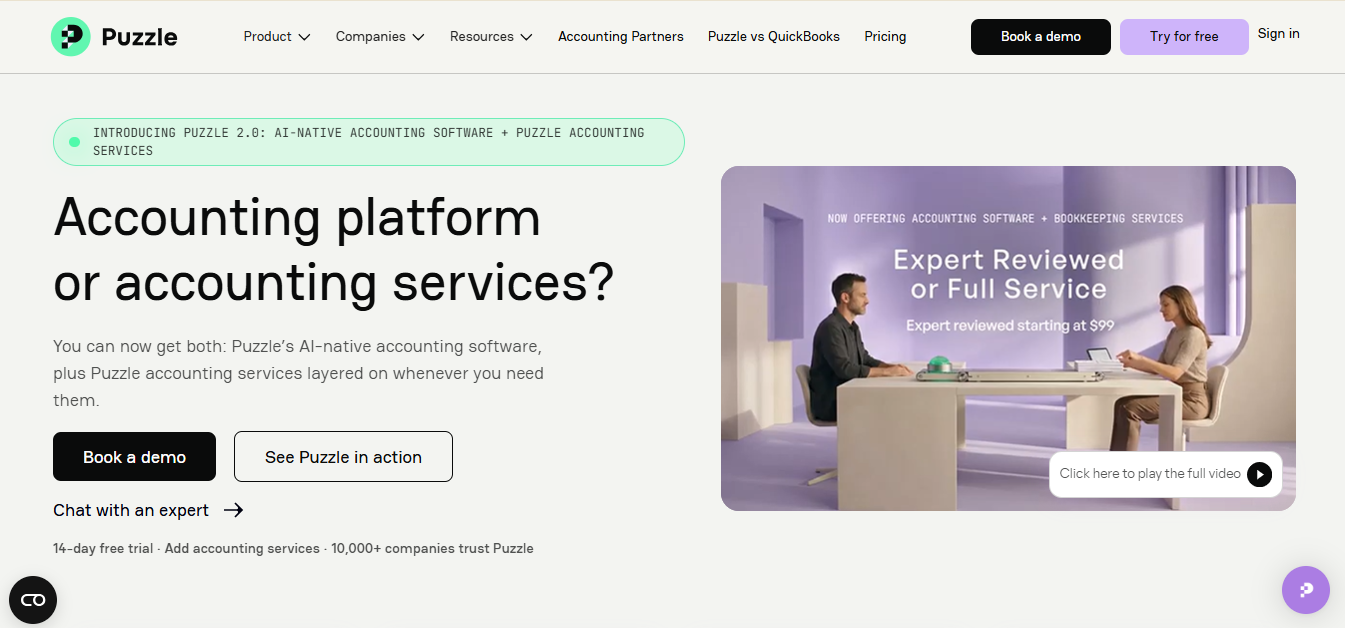
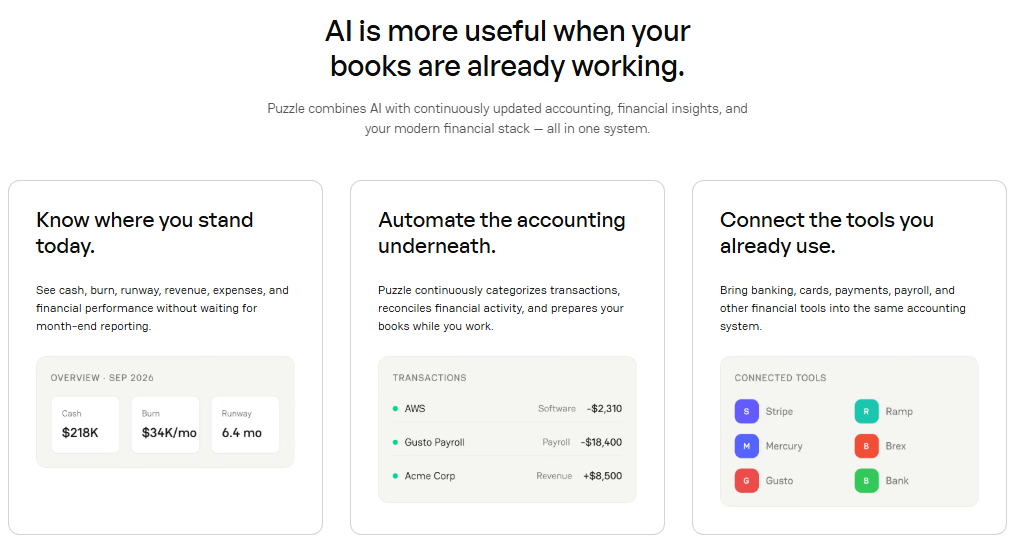
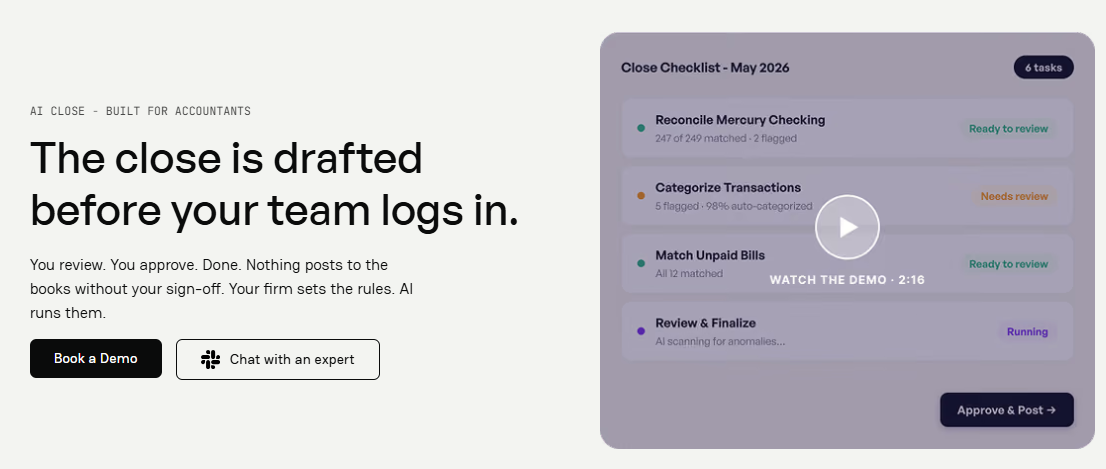
In my opinion. Puzzle’s AI Suite is landing best with accounting firms that serve startups and with founders whose money already moves through Stripe, Mercury, Ramp, Brex, and Gusto. The defining design choice is that nothing posts to the ledger until a human approves it, which I really think is an excellent way to “keep your AI on a leash” so to speak.
That makes the suite slower than “fully autonomous” pitches on paper but much easier to defend when someone asks who signed off on the numbers. If you have an accountant or controller who will actually work the review queue, it is worth a trial. If nobody on your side will approve anything, you will end up with a very smart backlog.
What’s in the AI Suite?
The Puzzle AI Suite is three tools that run inside Puzzle’s general ledger rather than as an add-on that syncs to someone else’s.
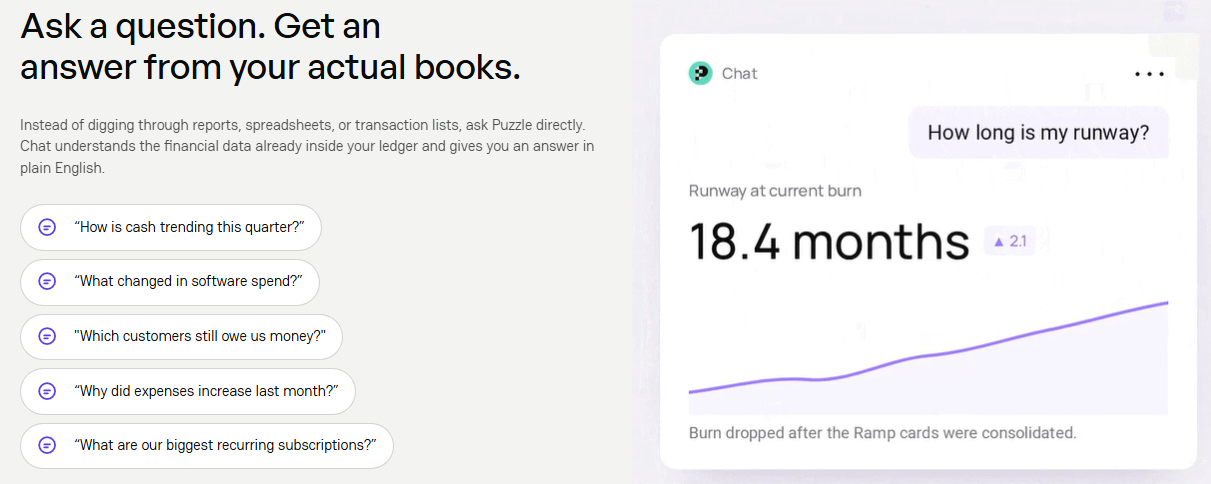
Chat answers plain-English questions about your books, such as why software spend jumped or which customers still owe you, and cites the transactions behind each answer. It is read-only and asks before it takes any action, so you don’t need to worry about it messing with anything it shouldn’t.
Cowork is the task agent. You describe a routine job in plain language, like matching invoices to payments, hunting down missing receipts, or flagging a first-time large charge from a new vendor, and it prepares the work for you to review.
Close is the piece aimed at accountants (hey, that’s me!). Basically, you describe month-end processes in plain English, and each task becomes an agent. The agents reconcile bank accounts from feeds, PDFs, or uploads, categorize using each client’s own rules, draft revenue recognition, payroll, depreciation, and amortization schedules, flag fixed assets placed in service, review journal entries for anomalies, and write variance explanations in normal language. They even put together prep notes for client calls.
Why the Human-in-the-Loop Design Matters
Here’s where I think most reviews of AI accounting tools go wrong. They grade the AI on how much it does by itself. That’s the wrong test for anything that ends up on a balance sheet a lender or an investor is going to read.
There are two broad ways to design this. One lets the software post anything it’s confident about and kicks the rest to a human. The other drafts everything and posts nothing until someone signs off. The first saves more clicks. The second keeps a person accountable for every number. Puzzle picked the second on purpose, and I think that’s the right call, because AI can automate tasks but it can’t automate accountability.
I’ve cleaned up after the alternative. When an automated rule miscodes a recurring vendor for six months, the problem isn’t the one bad entry. It’s that nobody looked at any of them. A review-first design doesn’t stop the AI from being wrong. It makes sure a human sees the mistake while it’s still one transaction instead of sixty.
The tradeoff is real, though. Approve-everything only works if someone is approving. Puzzle’s model assumes a reviewer exists, whether that’s your controller, your fractional CFO, or your outside firm. Without one, the drafts simply pile up.
Pricing and How AI Credits Work
You’re probably reading this and wondering what all this cost because it sounds expensive right? Pricing is refreshingly simple on one point: Puzzle includes the AI Suite in every software plan instead of selling it as a separate add-on. Chat, Cowork, and Close show up on all four tiers. What changes from plan to plan is how many AI credits you get and which Close capabilities are switched on.
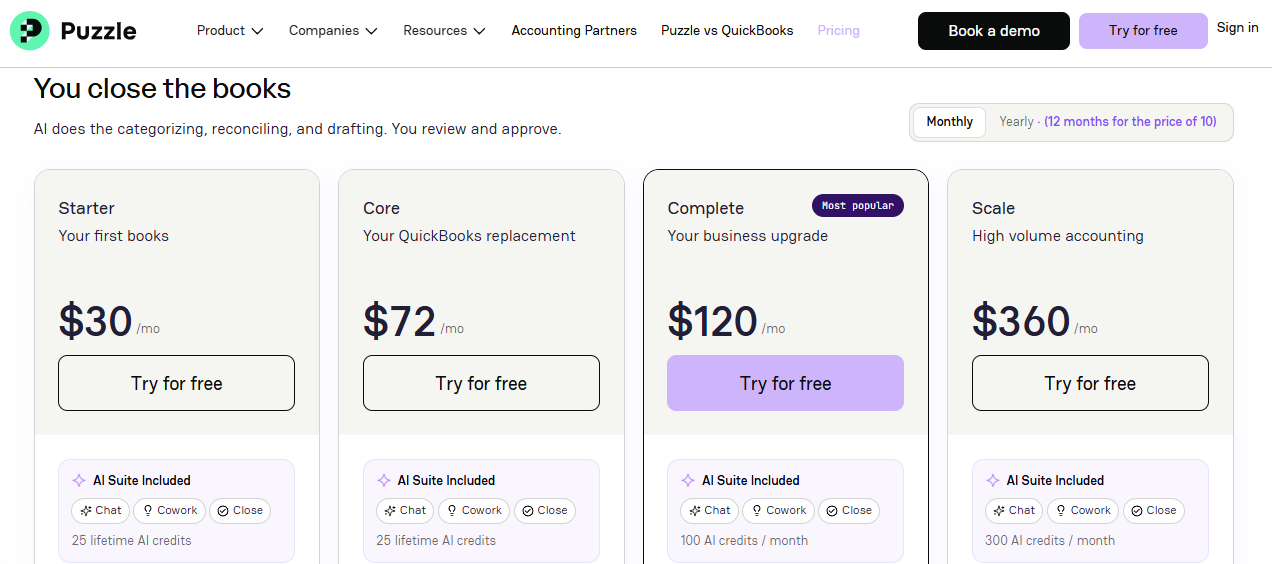
| Plan | Monthly price | AI credits | What it means in practice |
| Starter | $30 | 25, lifetime | Enough to test Chat and try a close, not to run one every month |
| Core | $72 | 25, lifetime | Same credit pool as Starter, with more reporting and up to five seats |
| Complete | $120 | 100 per month | First tier with refilling credits, AI reconciliations, and the AI accuracy review |
| Scale | From $360 | 300 per month | Higher volume, subledgers, and no transaction or integration limits |
Those are month-to-month prices. Annual billing takes roughly 20% off.
Here’s how the credits connect to the features. Chat, Cowork, and Close all draw from the same pool. Puzzle’s pricing page doesn’t publish a per-feature rate card, but third-party breakdowns and my personal experience describe it as roughly one credit per AI action. In practice, that means each Chat question, each Cowork job you hand off, and each Close task agent that runs is spending from the same balance. A close built from a dozen task agents will use far more credits in a month than a founder asking Chat a few questions.
That’s why the “lifetime” label on Starter and Core are important. Those 25 credits don’t refill, so they work as an extended test drive rather than an operating budget. Complete is the first plan where credits reset monthly, and it’s also where the AI-powered reconciliations, the AI accuracy review, revenue recognition, and class and department tracking come in. Most funded startups, and any firm planning to run Close every month, will end up on Complete or above.
User Reviews
Independent reviews are still few and far between. At the time of writing, G2 lists just three reviews of Puzzle with an average of 3.8 out of 5, and Capterra has none yet. Most of that feedback, along with the Reddit chatter, predates the AI Suite, so it’s really a review of the platform underneath it.
The praise is consistent: a clean interface that founders without a finance background can follow, real-time bank sync that cuts manual entry, and a dashboard that puts burn, runway, and revenue in one place. The older criticism centers on control and onboarding. Some users found that when the AI miscategorized something, fixing it was harder than it should be, and a few described rough onboarding and support experiences. The approval-first design of the AI Suite is aimed squarely at that first complaint.
There are some case studies too, though take them with a pinch of salt as Puzzle would naturally showcase its more impressive results. Still, Accountalent, a firm with more than 7,500 startup clients, reports its close dropping from 15–20 days down to 3–5 days, with 98% of transactions auto-categorized.
How to Read the Numbers
Every figure above comes from Puzzle or its customers, so it’s worth taking all of that with a mountain of salt. In my experience, a firm that agrees to be a launch case study is usually a firm with clean client files, a standardized close, and staff who were excited to try it.
Some other things are worth keeping in mind. First, the 98% auto-categorization claim that Puzzle boasts about leaves 2%, and in my experience that 2% is where the trouble lives: the transfer that looks like revenue, the owner contribution, and the refund booked to an expense account. The question isn’t whether the AI gets most things right. It’s whether the leftovers are easy to find and easy to fix.
Second, a faster close is partly a function of the firm’s own process. Close is built on the firm describing its steps, so a firm with a fuzzy process will be automating a fuzzy process. Bringing in a fractional controller can help mitigate this, or having one on staff will help ensure that the transition is clear cut and picturesque.
Who It Fits and Who Should Wait
It fits accounting firms that serve venture-backed or digital-first companies and want the close to run inside the ledger rather than across a checklist tool, a spreadsheet, and a separate reconciliation app. It also fits founders whose money already moves through the integrations Puzzle supports natively and who have someone, in-house or outside, who will review the work weekly.
It should wait for businesses carrying meaningful inventory, job costing, or messy multi-entity structures, which Puzzle isn’t built around today. It’s also a tough fit for founders who want the whole function to disappear. Puzzle does sell bookkeeping services delivered by a partner firm if you’d rather not do the review yourself, but at that point you’re buying a service, and you should evaluate it like one.
Wrapping Up
The honest summary is that Puzzle AI Suite reviews are few but positive, and the platform is built on a philosophy I’d rather defend in front of an auditor than the alternative. The launch-firm results are impressive and also exactly what you’d expect a launch partner to report. The independent reviews are thin, and the older criticisms center on control and onboarding, which the approval-first design is meant to address.
If you have a person who will own the review, give it a real month on a plan with enough credits to run your close, and judge it on your own books. If you don’t, solve that first. No AI suite, Puzzle’s, or anyone else’s, fixes the problem of nobody looking at the numbers.